
By Abdullhai A Nur
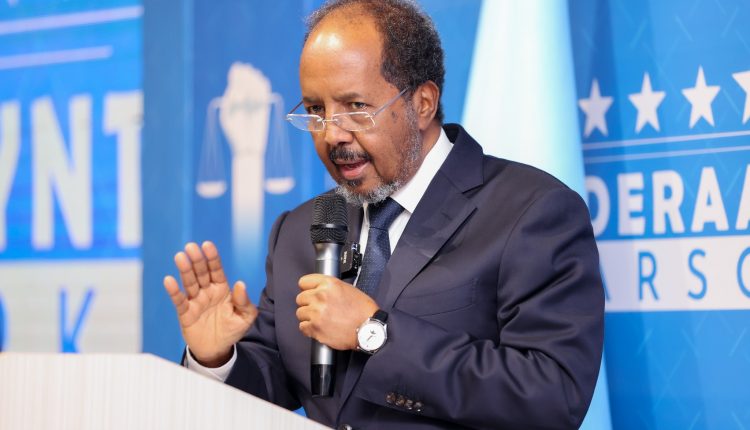
In the dimly lit corridors of Villa Somalia, power is being rearranged behind closed doors. Reliable sources confirm that President Hassan Sheikh Mohamud recently convened a series of secret meetings with his electoral committee and the speakers of both Houses of Parliament. The agenda was not reform or reconciliation. It was an audacious plan to extend his government’s mandate by two years, beginning May 16, 2026.
Officially, had President Hassan genuinely spent the nearly four years of his tenure laying the groundwork for universal suffrage, an extension could have been justified as a logistical necessity — a reasonable measure “to organize credible national elections.” In reality, however, it is nothing more than a calculated political maneuver designed to extend his hold on power, entrench his circle of loyalists, and sustain a corrupt system that has drained Somalia’s institutions of integrity and purpose.
This would be farcical if it were not so familiar. The same political figures who today defend this “technical extension” were once ferociously opposed to it. Under President Farmaajo, when the former Independent National Electoral Commission led by Halimo Ismail “Halimo Yarey” requested 15 to 18 months to prepare a one-person-one-vote election, Hassan Sheikh’s allies dismissed it as dictatorship. Now, they march in lockstep behind the very same argument.
It is hypocrisy at the highest level — a betrayal of principle and a confirmation that Somalia’s politics is not driven by ideas, but by appetite.
A Constitution in Tatters
Somalia’s constitutional framework was built on a strong parliamentary foundation — a system meant to ensure checks, balance, and accountability. Under President Hassan, however, that framework is being systematically dismantled. He governs as though the law were optional and legitimacy a personal entitlement. The proposed term extension has no constitutional grounding; it directly contravenes the Provisional Federal Constitution, which clearly stipulates fixed terms for both the presidency and parliament.
But the real tragedy is not legal — it is moral. Somalia’s fragile democracy, built through years of negotiation and sacrifice, risks collapsing into another cycle of authoritarian rule disguised as “stability.”
If carried out, this term extension risks triggering widespread political unrest, potential armed clashes, and the unraveling of Somalia’s fragile federal system. The scars of the 2021 electoral crisis — when forces loyal to rival factions under President Hassan exchanged gunfire with government troops in the streets of Mogadishu — remain raw. Yet Villa Somalia appears determined to repeat history, mistaking public silence for acquiescence and civic fatigue for loyalty.
Democracy in Name, Dictatorship in Practice
President Hassan Sheikh’s government has mastered the art of pretending. It speaks the language of democracy but rules by decree. It proclaims “universal suffrage” even as Al-Shabaab controls vast territories in the south, making a one-person-one-vote election logistically and morally impossible.
Instead of fostering cooperation with Federal Member States (FMS), Hassan Sheikh has pursued confrontation. He bars civilian flights to towns in Jubaland State; he pressures regional leaders through economic isolation; and he uses the Somali National Army not to defend the nation, but to intimidate Jubaland and Puntland FMS.
In every act, he displays not leadership, but fear — the fear of losing control.
A Government Feeding on Poverty
Each year, the citizens of Mogadishu are told that the national budget has grown. In 2025, the health budget stands at $92.6 million — almost one hundred million dollars. But the hospitals are still without medicine, staff go unpaid, and newborns die for lack of a single ventilator.
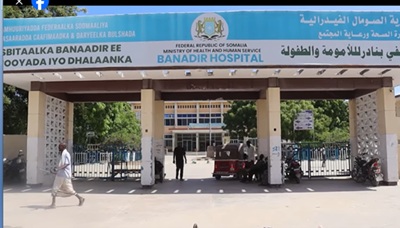
At Banadir Maternity and Children’s Hospital, the scene is one of quiet despair. Nurses work without pay, doctors vanish during night shifts, and patients are told to bring their own medicines, if they can find them. There is only one functioning machine to help newborns breathe. Recently, a mother was kicked out of the hospital and forced to give birth out in the open, her newborn did not survive.
Even the fuel that keeps the generators running at the hospital, must be begged from Hormuud Telecom. It is a heartbreaking reflection of a system that has abandoned its most vulnerable.
This is not a health system; it is a national disgrace.
Yet, in the same city, public lands are sold to businessmen close to the president. Villa Somalia has become a marketplace for influence and real estate. Mothers give birth in the dark while ministers build mansions in Nairobi. The president preaches reform, but governs like a merchant of misery.
As St. Thomas Aquinas once wrote: “ he who is not angry when there is just cause for anger is immoral… for anger looks to the good of justice.” If we can watch this decay and feel no anger, we have already surrendered our moral compass.
The Fiqi Scandal and the UAE Connection
While Somalia’s hospitals struggle to provide basic care, millions of dollars move silently through political channels. In recent weeks, Defense Minister Ahmed Moalim Fiqi has come under intense scrutiny after exposing a clandestine UAE mercenary operation routed through Bosaso Airport. His revelations followed reports that President Hassan Sheikh Mohamud received $5 million from the UAE, allegedly in exchange for Somalia’s abstention from a UN Security Council vote condemning Abu Dhabi’s role in Sudan’s conflict.
The consequences have been immediate and severe. The UAE, previously a key financier of Hassan Sheikh’s re-election ambitions, is reportedly incensed. The president, meanwhile, feels personally betrayed—not on ethical grounds, but because a confidential deal has been made public.
Inside Villa Somalia, panic and mistrust are spreading. Fiqi has been branded a traitor by the president’s inner circle, speculation of an imminent cabinet reshuffle to remove him is rife, and Hassan Sheikh’s credibility is tumbling both domestically and internationally. What began as a scandal involving mercenary operations has rapidly become a stark symbol of Villa Somalia’s systemic moral and political decay.
International Silence and Complicity
Somalia’s international partners cannot claim ignorance. Their silence during the illegal term extensions in Hirshabelle, Galmudug, and South West States set the stage for this national crisis. Donor governments and UN agencies continued business as usual with illegitimate regional administrations, signaling that democratic norms are negotiable.
Now, as Hassan Sheikh prepares to extend his own term, those same partners risk becoming complicit again. Their “strategic patience” has become moral negligence. If the international community remains passive, it will not just be enabling corruption — it will be burying Somalia’s democracy with diplomatic smiles.
The clock is ticking. On May 15, 2026, the constitutional mandate of this government ends. Every day beyond that date without a legitimate transition will deepen the crisis and hasten the collapse of the state itself.
The Anatomy of Dictatorship
Hassan Sheikh’s behavior follows a familiar pattern described by students of tyranny throughout history:
1) A dictator feels neither shame nor compassion, but he fears exposure — of his crimes, his wealth, his secrets.
2) He resents others’ success, believing goodness must belong only to him.
3) He creates nothing, only imitates foreign models and borrowed ideas.
4) He surrounds himself with flatterers, those who tell him the country is thriving and that he is God’s chosen servant.
5) He believes in his own mythology — that without him, the nation would perish.
It is the same old story told in different languages: the ruler who believes he is indispensable becomes the one most dangerous to his nation.
The Sudan Mirror
There is an eerie symmetry between Mogadishu and Khartoum. When Sudan brought its genocide case against the UAE before the International Court of Justice in 2025, it was dismissed on a technicality. Only one judge — the Somali jurist Abdulqawi Ahmed Yusuf — dissented. He warned that law must serve humanity, not procedure.
That same principle applies now to Somalia. When legality becomes a shield for tyranny, and when procedure justifies injustice, the state becomes hollow. Hassan Sheikh’s legalistic excuses for extending power are no different from the ICJ’s procedural justifications for denying Sudan its day in court — both are triumphs of form over conscience.
A Nation on the Edge
Somalia stands at a dangerous crossroads. The promise of “one-person-one-vote” has dissolved into fantasy. The federal system is collapsing under the weight of mistrust. The economy is suffocating while public funds vanish into private hands.
The president who once spoke of reconciliation now rules by intimidation. The man who once championed democracy now plots its undoing.
History is not kind to those who confuse authority with ownership. Every despot believes he can silence his people, buy his allies, and outwit time. But in the end, time outwits them all.
The Caution of Conscience
Somalia’s crisis is no longer political; it is moral. It is about whether truth still matters, whether justice still has a voice, and whether the Somali people can reclaim a government that serves them rather than feeds on them.
President Hassan Sheikh Mohamud may believe he can delay elections, silence critics, and trade state power for personal gain. But he cannot postpone the judgment of history.
When mothers give birth in darkness while leaders dine in luxury, the nation itself becomes a crime scene.
And when the people finally rise — as they always do — history will record not just the names of the guilty, but the silence of those who knew and said nothing.
Abdullahi A. Nor
Email: abdulahinor231@gmail.com
—————
Political Analyst and Constitutional Expert
Related articles
Investigative Brief: Presidential Accountability and the Sale of Public Lands By Abdullahi A. Nur
Foreign Minister Fiqi: A Diplomatic Liability or a Symbolic Appointee? By Abdullahi A. Nur