
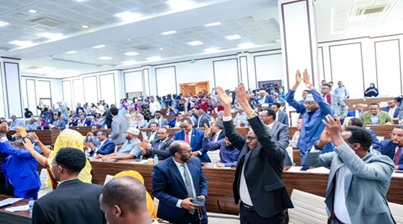
Mogadishu (WDN) — Somalia’s Federal Parliament has once again come under scrutiny after lawmakers voted down an opposition motion seeking to place the Doolow attack on the parliamentary agenda—a decision critics say exposes a legislature that has become more responsive to Villa Somalia than to the Somali public.
The vote came during a tense parliamentary session in which opposition lawmakers sought to force a debate over the attack on former Custodial Corps Commander General Mahad Abdirahman “Shub” at his residence in Doolow. The motion was rejected by a decisive margin. According to the parliamentary session, 165 lawmakers were present. Of those, 118 voted against adding the Doolow incident to the agenda, while 45 supported the motion and two abstained. The result triggered loud exchanges and disorder in the chamber as government and opposition lawmakers confronted one another over the politically sensitive issue. But the significance of the vote extends beyond the Doolow incident.
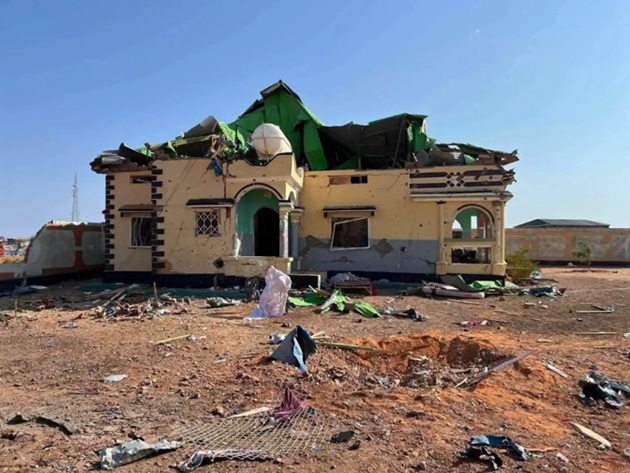
Somalia’s Federal Parliament has been operating beyond the expiry of its constitutional mandate since April 2026, yet it continues to exercise legislative authority amid an unresolved national political and electoral crisis. Critics argue that the legitimacy problem is compounded by the parliament’s record during the period in which it still held a valid mandate.
Rather than functioning as an independent check on executive power, the chamber has became a political theatre serving the president. Its frequently been portrayed by opposition groups and civil-society critics as an extension of Villa Somalia, approving presidential initiatives no limited scrutiny. The latest Doolow vote has revived that criticism. The question is no longer simply whether Parliament can pass legislation. It is whether it is willing to hold the executive accountable when the government itself becomes the subject of serious allegations.
During the tenure of former Speaker Sheikh Adan Mohamed Nur “Adan Madoobe,” critics frequently used the nickname “Approved” to mock what they described as Parliament’s readiness to endorse government-backed proposals. The label reflected a widespread perception that presidential initiatives could move through the chamber with no resistance. More seriously, critics have questioned whether parliamentary sessions and votes have complied with the required attendance and procedural thresholds. Such concerns strike at the heart of parliamentary legitimacy.
A parliament is not supposed to exist merely to endorse decisions already made by the executive. Its fundamental functions include scrutinizing government policy, challenging executive decisions, representing constituents and protecting the public interest. When those functions are weakened, Parliament becomes an instrument of executive power rather than a check on it.
The Politics of Patronage
President Hassan Sheikh Mohamud’s administration has built political loyalty among lawmakers through patronage, including land allocations, financial benefits and other political favors. If lawmakers believe their political survival or personal interests depend on maintaining loyalty to the presidency, their ability to represent constituents independently is inevitably questioned.
The result, is a parliament whose members have become more responsive to the interests of those controlling government patronage than to the citizens. That is the difference between representation and political dependency. The attempt to bring the Doolow attack before Parliament, was a test of principle and offered the lawmakers an opportunity to demonstrate responsibility and independence.
Opposition MPs, including Yusuf Gamaadiid and Dahir Amin Jesow, reportedly pushed for the incident to be added to the agenda so Parliament could debate what happened and determine whether further action was required. They failed.
The 118–45 vote against the proposal immediately became a political statement in itself. It does not establish who was responsible for the Doolow attack. That remains a matter for an independent investigation. But it does raise a separate question: Why would Parliament refuse even to debate an incident involving a former senior national security official who was reportedly wounded in an attack?
Representing Constituents—or Themselves?
The deepest criticism facing Somalia’s parliament is therefore not about one vote. It is about representation. Somali citizens expect their lawmakers to speak for communities facing insecurity, displacement, poverty, political exclusion and weak institutions. They do not elect MPs merely to protect government interests. Nevertheless, many believe that Somalia’s lawmakers are a product of the very corrupt political system that put them in office—a process in which ordinary citizens had no role, no voice, and no meaningful say in choosing those who claim to represent them.
Parliamentary independence is measured not by speeches but by difficult votes. It is tested when the executive disagrees. It is tested when the government is accused of wrongdoing. It is tested when opposition lawmakers demand an investigation. And it is tested when a politically uncomfortable issue must be placed on the national agenda. The Doolow vote was precisely such a moment.
The government and its supporters may argue that Parliament was simply exercising its procedural authority. That is a legitimate position. But a legislature unwilling to investigate allegations involving the national interest or the abuse of power is failing in its fundamental duty.. The distinction matters. Somalia cannot build a credible democratic system if its institutions are extensions of political power. it’s a cost to Somalia’s democracy.
An expired parliament already faces questions about its legitimacy. A parliament accused of routinely following Villa Somalia’s direction faces a deeper crisis of public confidence. And a legislature that refuses to debate politically sensitive allegations risks reinforcing the perception that accountability ends where presidential power begins. That is dangerous for a country already struggling with disputes over elections, constitutional reform, federalism and the distribution of political authority.
The Question Somalia Must Answer
The Doolow motion may have been defeated, but the questions it raised will not disappear. Who does Somalia’s parliament represent? Does it represent the presidency? Does it represent the interests of individual MPs? Or does it represent the Somali people?
The parliamentary mandate expired in April, 2026. The country still lacks a broadly accepted political settlement over the next electoral and constitutional order. Yet the same political machinery continues to operate.
For critics, the latest vote is another indication that Somalia’s legislature has failed to develop the independence required of a genuine democratic institution. A parliament should not exist to say “approved” whenever the presidency points. It should exist to ask questions, demand evidence and hold power accountable.
The Doolow vote has therefore become more than a parliamentary procedural dispute. It has become a test of whether Somalia’s legislature can still claim to represent the people—or whether it has become another arm of Villa Somalia.
WardheerNews