
By Ahmed A. Yusuf
Under the Provisional Federal Constitution of the Federal Republic of Somalia (PFCS), the term of office of the Federal Parliament is unambiguously defined. Article 60 stipulates that the mandate of the Federal Parliament is limited to four years, commencing from the date on which election results are officially announced. This provision applies equally to both chambers of Parliament—the House of the People and the Upper House (Senate)—as set out in the Constitution adopted in 2012. Pursuant to Article 91 of the Provisional Federal Constitution, the President’s term of office is expressly fixed at four years, with no provision for unilateral extension.
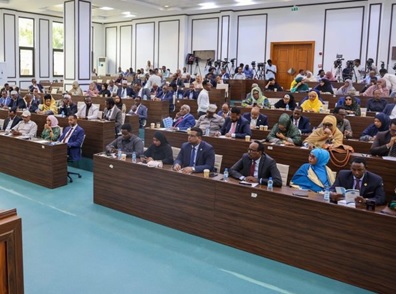
On this basis, the current 11th Federal Parliament, which began its term in April 2022, is constitutionally scheduled to expire in April 2026. Parliamentary elections are therefore expected to be concluded before that date, in accordance with an agreed electoral framework. The Constitution does not provide for an automatic extension of parliamentary terms.
This constitutional clarity has placed the 2024 constitutional amendments at the center of an escalating political and legal dispute. Critics argue that the amendments—particularly those affecting parliamentary tenure—contravene the explicit language of Article 60. They further maintain that any alteration to the parliamentary term requires strict compliance with constitutional amendment procedures, including broad consultation, institutional safeguards, and the meaningful participation of Federal Member States.
The controversy extends beyond parliamentary tenure to the formation of electoral institutions. Under the PFCS, the National Independent Electoral Commission (INEC) is established as a constitutional body under Article 111G. While the article creates the Commission, it does not grant the President unilateral authority over its composition. Instead, the Constitution envisages a consultative and institutional appointment process designed to preserve the Commission’s independence.
This requirement is reinforced by Article 111, which governs all independent constitutional commissions. It mandates political neutrality, independence from the executive, and appointments based on competence, integrity, and broad public acceptability. Legal analysts argue that a commission constituted solely through executive action, without approval of federal consultation, fails to meet these constitutional standards.
Federalism further complicates the issue. Articles 52 and 120 distribute authority between the Federal Government and the Federal Member States, underscoring that elections are not an exclusive executive function. Federal Member States are constitutional stakeholders, not administrative subordinates, and their exclusion from national electoral arrangements is widely viewed as inconsistent with both the letter and spirit of the Constitution.
The limits of presidential authority are also clearly defined. Articles 87 to 91, which set out the powers of the President, do not authorize unilateral constitutional amendments, the formation of constitutional commissions without oversight, or the extension of parliamentary mandates outside constitutional procedures. Constitutional scholars note that, in such cases, the absence of explicit authority amounts to a lack of legality.
Additionally, Article 120 requires that elections be conducted strictly in accordance with law and under legislative frameworks, rather than executive decrees. Electoral bodies established without enabling legislation or federal consultation therefore face serious questions regarding their legal standing.
At the heart of the dispute is the allegation that the President proceeded to alter the Provisional Constitution without following the constitutionally mandated amendment process and without meaningful consultation with Federal Member States, political actors, or the public. Critics argue that this approach risks treating the Constitution as an administrative instrument rather than a binding social contract.
Tensions intensified further when Parliament approved an extension of its own term by one additional year. Opponents of the move contend that extending the mandate of sitting legislators who voted on the amendments raises concerns about conflict of interest and undermines the legitimacy of the process.
As a result, the amendments remain deeply contested. Federal Member States—most notably Puntland and Jubaland alongside constitutional scholars and concerned citizens, argue that the process weakened federalism, eroded checks and balances, and established a precedent in which constitutional limits are subordinated to executive convenience. Whether these changes can withstand legal and political scrutiny remains an open question, one that continues to shape Somalia’s fragile constitutional order.
Against this backdrop, questions persist about the core agenda of the consultative forum scheduled for 1 February. Setting aside broader allegations related to governance, observers argue that three urgent constitutional and electoral issues must be addressed to prevent further political fragmentation:
1) Reversal of the four chapters of the Constitution amended on 30 March 2024, and a return to the Provisional Federal Constitution approved on 1 August 2012, pending a lawful and inclusive amendment process.
2)Agreement on a workable and broadly accepted electoral model, particularly given the narrow time remaining to complete the electoral cycle.
3) Establishment of a genuinely independent and consensual Federal Electoral Commission, constituted in accordance with constitutional requirements.
4) Villa Somalia is to rescind the warrant issued against President Ahmed Madobe of Jubaland.
Without progress on these core issues, analysts warn that Somalia risks entering another period of constitutional uncertainty, with serious implications for political stability and national cohesion.
Ahmed A. Yusuf
Email: aayuusuf44@gmail.com