
By Eng Mohamed Ali Mirreh
A Capital Under Siege: The Latest Developments in Mogadishu
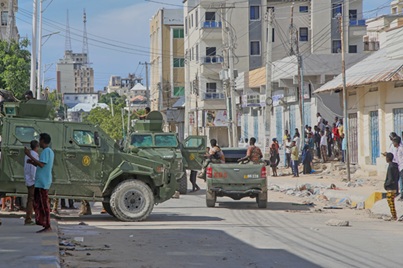
Mogadishu is once again gripped by fear, uncertainty, and the sound of gunfire. In recent days, clashes have intensified across key districts—particularly around Abdiaziz, Mirinayo, and Wadajir as opposition‑aligned security units and government forces confront each other in a dangerous escalation. Residents describe road closures, heavy troop movements, and artillery exchanges that have forced thousands of civilians to flee their homes. Humanitarian agencies warn that the capital is sliding into a multi‑layered political and security crisis reminiscent of the darkest chapters of Somalia’s recent history.
Diplomatic sources in Xalane confirm that negotiations have stalled, with neither side willing to concede ground. The president’s camp insists it is defending “constitutional order,” while the opposition argues that it is resisting an illegal extension of power and the dismantling of Somalia’s fragile federal system. The atmosphere in Mogadishu today is one of fear, exhaustion, and deep political fragmentation.
The Roots of the Crisis: A Presidency That Outran Its Legitimacy
At the heart of the turmoil lies a presidency whose legal mandate expired on 15 May 2026. Instead of facilitating a consensual transition, the president embarked on a series of unilateral actions that many Somalis view as the primary drivers of the current instability. Rather than adhering to the 2012 Provisional Constitution, he pursued a personalized constitutional rewrite, bypassing political stakeholders and federal member states. The resulting “constitution” was rushed through a parliament widely accused of corruption, with allegations that MPs were bribed to approve the changes.
In defiance of established norms, the president appointed his own national election commission without consultation. This move shattered trust in the electoral process and convinced many that he intended to engineer a controlled, one‑man‑one‑vote system designed to secure his continued rule. Perhaps the most explosive grievance is the alleged seizure of state lands in Mogadishu. Thousands of families were reportedly evicted, their homes demolished to make way for private developments linked to the president’s relatives and business allies. This pattern of personal enrichment, nepotism, and patronage has fueled public anger and deepened the legitimacy crisis.
The president also sidelined the Golaha Mustaqbalka, opposition parties, and respected national figures. Agreements reached with political groups were repeatedly broken, reinforcing the perception of a leader unwilling to compromise or govern through consensus.
The Opposition Bloc: Former Presidents, Prime Ministers, and Federal States
The opposition today is not a fringe movement. It is a coalition of former presidents, former prime ministers, influential political figures, and the governments of Puntland and Jubaland. This bloc considers the president a former leader whose mandate has expired and whose unilateral policies are illegitimate. Their stance is rooted in defending the federal system, rejecting constitutional manipulation, protecting state autonomy, and resisting authoritarian consolidation. Their strength lies in political legitimacy, territorial control, and broad public support, especially among communities affected by land seizures and disenfranchisement.
The International Community: A Fragmented External Influence
Another actor in the Somali crisis, is the role of the international community. Somalis widely believe that the international community, headquartered in Xalane, is not a neutral actor. Its internal divisions and competing agendas have complicated the crisis. The United States and the European Union are perceived as pursuing security‑first agendas, often prioritizing counterterrorism over democratic governance. Their silence on constitutional violations has fueled suspicion.
The United Kingdom and Denmark openly support the Somaliland secessionist project, which many Somalis interpret as tacit endorsement of fragmentation. The United Arab Emirates has long sought influence over major Somali ports, as seen in Berbera and Bosaso, and although the Iran–US confrontation has slowed its ambitions, it has not eliminated them. Turkey remains the president’s strongest foreign backer, driven by fears that a new Somali leadership might revisit or revoke oil, gas, and fisheries agreements signed without parliamentary approval. The result is an international community that is divided, inconsistent, and increasingly mistrusted.
Three Possible Scenarios for Somalia’s Immediate Future
Somalia now stands at a crossroads. Based on current dynamics, three plausible scenarios emerge.
In the first, the president temporarily defeats the opposition in Mogadishu and imposes short‑term control. But such a victory would be fleeting. History offers sobering parallels: Ashraf Ghani fled Afghanistan after losing legitimacy and public trust; Ferdinand Marcos was driven out by mass protests despite military backing; Sheikh Hasina faced overwhelming unrest after years of authoritarian rule. A president ruling through force, without consensus, risks eventual collapse, public revolt, and international isolation.
The second scenario is the nightmare: a descent into civil war reminiscent of 1991. With clan‑based militias mobilizing and political alliances hardening, Somalia could slide into a multi‑front conflict. The consequences would be catastrophic—mass displacement, the collapse of federal institutions, the fragmentation of the national army, and the rise of warlordism and regional secession. Every Somali prays this outcome never materializes.
The third scenario is the formation of a parallel government. The opposition, backed by Puntland and Jubaland, could establish an alternative authority in Garowe or Kismayo. If the international community concludes that the president has lost legitimacy and control, it may eventually shift its support. This scenario carries the least immediate damage, but its success depends entirely on the quality of leadership that emerges.
For such a government—or any future Somali administration to succeed, the country requires a new kind of leadership, radically different from what it has endured over the past three decades. Somalia needs a leader who builds consensus rather than rules unilaterally, who embodies integrity instead of corruption, who respects federalism rather than centralization, who protects public land and resources, who ensures transparency in contracts and foreign agreements, who includes elders, women, youth, and civil society, and who prioritizes a long‑term national vision over short‑term political survival. Somalia’s stability depends on reconciliation among clans, strengthening federal member states, reforming the security sector, ending land theft and displacement, building institutions rather than personal empires, and restoring trust between the state and its citizens. Such leadership is not merely desirable—it is existentially necessary.
Conclusion:
Mogadishu’s current crisis is not just a political dispute—it is a battle for the soul of the Somali state. The president’s unilateral actions, constitutional manipulation, and exclusionary governance have pushed the country to the brink. The opposition, federal states, and civil society now stand at a historic moment where their decisions will shape Somalia’s trajectory for decades.
Whether Somalia descends into chaos or emerges with renewed leadership and national unity depends on the choices made in the coming days. Somalis deserve a future built on justice, consensus, and dignity—not fear, corruption, and authoritarianism.
Eng Mohamed Ali Mirreh
Email: m.mmirreh@gmail.com