
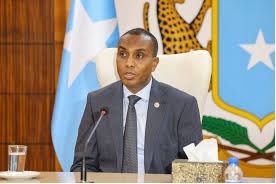
Mogadishu (WDN) – Somalia’s Federal Cabinet on Thursday approved a series of measures aimed at strengthening governance, modernizing public administration, and promoting economic reforms, while Prime Minister Hamza Abdi Barre urged government officials to use only Somali passports during official foreign travel.
The weekly Cabinet meeting, chaired by Prime Minister Hamza, focused on national security, economic development, judicial reform, and the digital transformation of government services. A key item on the agenda was a comprehensive briefing from the Ministry of Internal Security on the rollout of Somalia’s third-generation polycarbonate electronic passport (E-Passport).
Officials told the Cabinet that the new biometric passport incorporates enhanced security features designed to improve document integrity, facilitate international travel, and strengthen the global credibility of Somali travel documents. The ministry also announced that personal information on newly issued passports can no longer be altered after issuance, describing the measure as an important safeguard against fraud and document manipulation.
The Cabinet also reviewed first- and second-quarter (Q1 and Q2) performance reports submitted by government ministries, alongside progress on implementing an electronic Cabinet (E-Cabinet) system, a digital platform intended to modernize Cabinet administration, improve decision-making, and streamline government operations.
In a significant economic policy decision, ministers approved the Draft Law on Rules of Origin, introduced by the Ministry of Commerce and Industry. The legislation is expected to strengthen Somalia’s trade regulatory framework by establishing clearer standards for determining the origin of goods, improving quality control, and enhancing confidence in products traded both domestically and internationally.
Addressing the Cabinet, Prime Minister Hamza briefed ministers on his recent visit to the North Eastern State, praising what he described as the unity and cooperation demonstrated by the regional administration and its residents.
Prime Minister Hamza Abdi Barre also congratulated the people and administration of Galmudug following the completion of the state’s recent one-person, one-vote elections, describing the exercise as an important democratic milestone. However, critics reject that characterization, arguing that the reality on the ground tells a different story. They contend that the outcome had effectively been decided long before ballots were cast, with President Hassan Sheikh Mohamud’s Justice and Solidarity Party (JSP) candidate widely perceived as the predetermined winner. In their view, the election was little more than a managed political exercise designed to legitimize a prearranged outcome rather than reflect the genuine will of the electorate.
The Prime Minister called on all ministers and senior government officials to travel exclusively on Somali passports during official overseas visits, arguing that doing so reinforces the country’s sovereignty and enhances the international standing of the Somali state. Hamza also commended Second Deputy Prime Minister Jibril Abdirashid Haji for voluntarily renouncing his foreign passport, describing the decision as an act of patriotism and respect for Somalia’s national symbols.
Its important to note that the recent barring of several officials from President Hassan Sheikh Mohamud’s administration from entering Kenya has become a significant embarrassment for the Federal Government of Somalia, particularly in the absence of any apparent response or accountability from Mogadishu. The incident has also raised broader questions about the administration’s vetting and appointment process. The appointments are driven less by merit, competence, or integrity than by an individual’s proximity to the President, his family, or his inner circle, fueling strong concerns about favoritism and weakening public confidence in the credibility of government institutions.
The Cabinet concluded its session by approving a change to the membership of the Judicial Service Commission following a recommendation from the Ministry of Justice and Constitutional Affairs. Under the decision, Ali Macalin was replaced by legal expert Adan Kuulow Macalin Qasim, a move the government said is intended to further strengthen judicial administration and the rule of law.
Nevertheless, it is no secret that President Hassan exercises tight control over appointments throughout his administration. All recent nominations are widely seen as the sole work of the President, with little or no meaningful input from the relevant ministries or government institutions. Whether at the junior or senior level, virtually every appointment begins and ends in his office, leaving ministries and other state institutions with little meaningful authority over responsibilities that would ordinarily fall within their mandate.
WardheerNews