
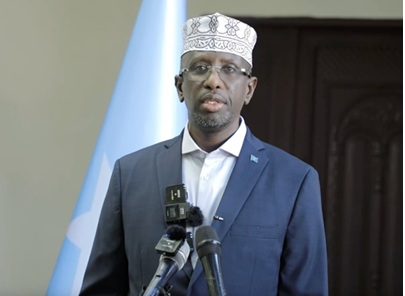
Mogadishu (WDN) – Former Somali President Sharif Sheikh Ahmed has launched a pointed critique of the Federal Government’s latest disarmament campaign in Mogadishu, questioning both its legitimacy and practicality while exposing what he described as a glaring contradiction at the heart of the initiative.
Speaking at a press conference in Mogadishu, Sharif argued that the government’s disarmament rhetoric has become detached from reality, noting that many of the weapons imported into the country are not even under the control of Somalia’s national security institutions.
According to the former president, the real issue is not civilians carrying weapons, but rather the widespread perception that state-owned arms have found their way into private hands.
“The weapons brought into the country are not in the hands of the national armed forces,” Sharif said. “They are controlled by specific individuals and stored in private residences. It is difficult to accept a situation where a president whose constitutional mandate has expired is accumulating weapons and then turns around and tells others to disarm.”
The remark drew immediate attention, highlighting the deep mistrust that continues to define relations between the government and opposition figures.
Sharif argued that any serious disarmament effort must be built on national consensus rather than political decrees. In a country where weapons have long been intertwined with security, clan dynamics, and political survival, he suggested that selective disarmament could easily be interpreted as a political project rather than a security initiative.
“A comprehensive agreement must come first,” he said. “Only then can a genuine disarmament process begin, and when it does, it should be implemented across the entire country simultaneously.”
Sharif’s comments reflect a broader concern among opposition leaders who fear that disarmament campaigns conducted in the absence of political consensus could alter the balance of power rather than improve public security. He reserved some of his sharpest criticism for President Hassan Sheikh Mohamud’s characterization of recent armed confrontations between government forces and opposition-linked elements.
The president had reportedly described the clashes as a minor disturbance. Sharif, however, appeared astonished by the description. “It is irresponsible for President Hassan Sheikh to describe as a ‘small incident’ a conflict that began in Mogadishu and whose consequences extended as far as Adale district in Middle Shabelle,” he said.
The criticism underscores a widening gap between the government’s portrayal of recent events and the opposition’s interpretation of the same developments. While officials have sought to minimize the significance of the confrontations, opposition leaders argue that the clashes exposed deeper political fractures and growing instability.
The debate has also revived a familiar question in Somali politics: can disarmament succeed in a climate where political trust is in short supply and accusations of weapon stockpiling are directed at the very authorities tasked with enforcing the policy?
For many observers, the spectacle has become increasingly difficult to ignore. Somalia’s leaders continue to speak passionately about reducing the number of weapons on the streets, yet accusations persist that some of the country’s most powerful political actors remain heavily armed behind guarded compounds and high walls.
The irony has not gone unnoticed. In a nation where almost every political dispute eventually circles back to questions of security and power, calls for disarmament often generate a simple response from skeptics: who exactly is disarming whom?
Until a broader political settlement is reached, Somalia’s disarmament debate risks becoming less about removing weapons and more about deciding who gets to keep them.
WardheerNews