
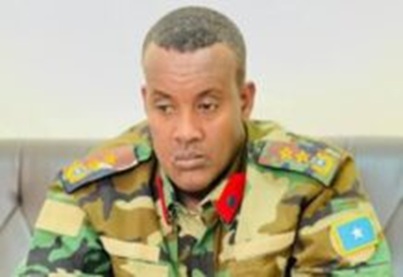
Mogadishu (WDN) — Reports indicate that tensions are escalating between forces led by Somali National Army officer Gen. Saneey Cabdulle and federal government troops, raising fears that an armed confrontation is no longer a possibility, but an imminent reality.
At the center of the standoff is a deepening dispute between Gen. Saneey and the Commander of the Somali National Army, Ibrahim Mohamed Mahmoud. The commander—recently elevated to his position by President Hassan Sheikh Mohamud—is widely viewed by critics as acting in line with the president’s political objectives, particularly at a moment of intense national uncertainty.
According to multiple reports, large numbers of government forces have been deployed around Gen. Saneey’s residence in Mogadishu’s Gubadley district, supported by armored vehicles, including tanks. The scale and urgency of the deployment signal that this is not a routine security operation, but a high-stakes confrontation.
The immediate trigger appears to be an order from military command requiring Gen. Saneey to hand over weapons allegedly belonging to the state—arms he is said to have taken into his control during the tenure of former army chief Odowaa Yusuf Rage. Gen. Saneey, however, disputes this claim, maintaining that the weapons are privately owned. Sources indicate that government forces have been instructed to detain him if he refuses to comply.
But the standoff cannot be understood in isolation. It is unfolding against a broader political crisis. The federal parliament’s mandate expired on April 14, and President Hassan Sheikh Mohamud’s own term is approaching its final days, with no clear consensus on the path forward. Amid mounting tensions, critics argue that the administration is increasingly relying on military pressure to contain opposition and maintain control.
This latest confrontation is widely seen as a direct extension of that strategy—one that carries significant risks. Rather than stabilizing the situation, it could accelerate fragmentation within the security forces themselves.
There are growing concerns that, in the event of open conflict, the so-called national army could fracture along clan lines—a scenario that would dramatically escalate instability in Mogadishu and beyond.
Both sides are now on high alert, and indications suggest that preparations for armed engagement are already underway. What happens next may determine not only the fate of Gen. Saneey, but the trajectory of Somalia’s political and security landscape in the weeks ahead.
WardheerNews