
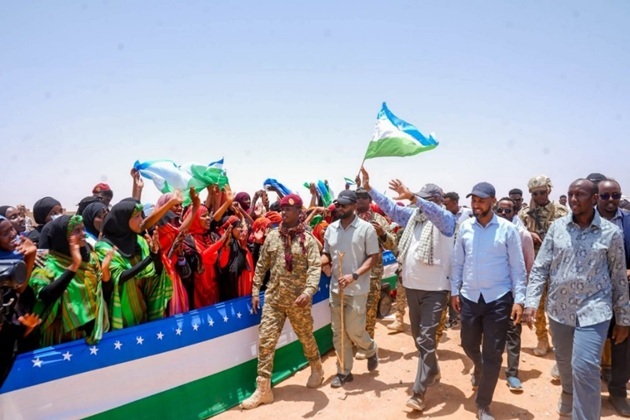
Garowe (WDN) — Puntland’s Road Advantage: Why Deni Can Reach His People by Road While Other Somali Presidents CannotDeni of Puntland is demonstrating something increasingly rare: the ability to travel by road, day or night, across his territory and reach even some of its most remote communities.
At the time of writing, President Deni is touring districts across Bari region, including areas far beyond the main paved road network. On Friday night, Deni and his delegation spent the night in Ufeyn after travelling through districts and settlements along roads outside the main highway.
The journey is part of a wider tour intended to assess conditions in Bari and strengthen security, particularly following military operations against militant groups in the Cal Miskaad area. Deni is expected to continue travelling through districts including Balidhidhin, Iskushuban and Hafun, accompanied by senior parliamentary officials, government representatives, presidential advisers, members of the presidential administration and military officers. The significance of the journey extends well beyond the itinerary.
Nevertheless, this comes amid growing frustration among many Puntlanders over government neglect and failure to fulfill its responsibilities. Citizens are facing severe economic and livelihood hardships, while even government employees have reportedly gone nearly a year without receiving their salaries.
A Rare Political Freedom in Somalia
Puntland’s relative security gives its president an advantage that leaders of most other Somali Federal Member States simply do not enjoy. Deni can leave Garowe, travel hundreds of kilometres over paved and unpaved roads, stop in towns and rural communities, meet local residents and government officials, and continue his journey without being confined to an aircraft or a heavily restricted security corridor. For much of Somalia, that kind of presidential outreach remains largely a dream.
The presidents of South West, Jubaland, Hirshabelle and Galmudug face vastly greater security constraints. Travelling overland between major population centers can involve serious risks because of militant activity, contested territory, road insecurity and the limited reach of government security forces.
President Hassan travelling from Mogadishu to Marka or Jowhar by air, for example, cannot take for granted the freedom of movement that Deni currently enjoys across much of Puntland. In practice, senior political leaders in several Federal Member States are heavily dependent on air travel to move between major locations.
The ability to travel by road is not simply a matter of convenience. It is a measure of territorial control, security, state presence and political access. A president who can drive through his territory has an opportunity to see conditions firsthand rather than relying entirely on reports from officials. He can meet communities that rarely receive high-level government visitors. President Deni’s journey through Bari is taking him into areas that are geographically distant and, in some cases, far removed from Puntland’s main urban centres.
Puntland is not the only Somali territory where senior leaders can travel overland. Somaliland also provides its president with significant freedom of movement across much of its territory. But among Somalia’s Federal Member States, Puntland’s current level of presidential road access stands out.
The contrast is particularly striking when measured against the security environment facing the federal states in south-central Somalia. A president who cannot safely travel between his own major towns by road is inevitably more dependent on air transport, security escorts and tightly controlled schedules. That limits political outreach. It also creates distance between government and citizens.
Deni’s Journey Sends a Political Message
The current tour also carries an important political message. By travelling beyond Garowe and visiting remote districts personally, Deni is reinforcing the image of a government that can physically reach its population. The delegation includes senior political, administrative and security officials, suggesting that the journey is intended not merely as a presidential visit but as an exercise in government outreach. The stated focus is security and the conditions of communities in Bari. But the symbolism is broader.
A government that can travel its roads can see its territory. A government that can see its territory can better understand its people. That connection is difficult to establish when political leaders are confined to capitals or forced to move almost exclusively by air.
Puntland’s relative security should therefore be understood not only as a security achievement but also as a political asset. Road access creates opportunities for governance. It allows officials to reach communities, communities to see their leaders, and leaders to gather information directly from the population.
It also gives the administration greater visibility across its territory. The contrast with much of southern and central Somalia is stark. In areas where Al-Shabaab remains capable of threatening major roads and where government authority is contested, presidential travel becomes a security operation rather than ordinary governance.
The result is a state that can be physically present in one location while remaining largely inaccessible elsewhere.
The Larger Somali Paradox
Somalia has invested heavily in rebuilding national security institutions, yet large parts of the country remain difficult or dangerous for political leaders to traverse by road. That creates a fundamental paradox: How can a government claim effective territorial governance when its own president cannot freely travel across the territory he is supposed to govern?
Puntland offers a different picture.Deni’s current journey—from established urban centres into remote districts and communities—demonstrates the practical value of security. It shows that roads can become instruments of governance rather than simply transport routes. And it highlights what other Somali leaders could achieve if they enjoyed comparable freedom of movement. The Real Measure of Security.
Security is often measured in statistics: territory recovered, militants eliminated, weapons seized or operations conducted. But there is another, more tangible measure. Can a president get into a vehicle and travel through his own territory?
Can he leave the capital at night? Can he travel on paved and unpaved roads? Can he reach remote districts without having to fly? Can ordinary citizens see their president arrive by road and speak directly to him?
In much of Somalia, the answer remains uncertain or negative. In Puntland, Deni’s current tour offers a strikingly different reality. That does not mean Puntland has eliminated every security challenge, nor does road access by itself prove effective governance. But it demonstrates something fundamental: security creates political space.
And at a time when many Somali leaders remain largely dependent on aircraft to move between their own territories, Puntland’s ability to move its president by road—across both highways and remote tracks—has become one of its most visible advantages. For Deni, the road is not merely a route between districts. It is a demonstration that his administration can reach the people it governs.
However, the question on everyone’s mind is whether President Deni will return ready to address the people’s growing hardships—or simply return with another round of photo opportunities and political promises.
WardheerNews