
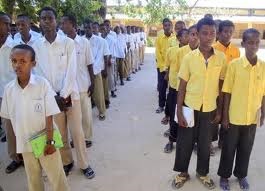
Garowe (WDN) — Puntland is preparing to remove one of the biggest barriers keeping children from school, with the government announcing plans to make primary and intermediate education free across the region, potentially bringing immediate financial relief to thousands of families once the policy takes effect.
Puntland Interior Minister Abdi Hersi Ali (Qarjab) said the government is moving quickly to implement the policy, which would eliminate school fees for children at the primary and intermediate levels. “The government is currently working to make primary and intermediate schools free of charge throughout Puntland, and we hope to implement this soon,” Minister Qarjab said during an event in Garowe.
The policy is expected to have its greatest immediate impact on orphans and low-income families, many of whom struggle to keep their children in school because they cannot afford tuition and other education costs.
For a poor household, removing school fees can mean the difference between a child attending school and staying at home. If implemented as announced, the policy could therefore put basic education within reach of children who have been excluded simply because their families cannot afford it.
A Policy with Immediate Consequences
Unlike a long-term education strategy, the proposed measure could deliver a direct and tangible benefit to families from the moment it takes effect: less money spent on school fees and more children able to remain in classrooms.
Minister Qarjab said the cost of the program would be shared between the Puntland government and the people of Puntland. However, authorities have yet to disclose the full budget, implementation mechanism or exact date when free education will begin.
Those details will be critical to determining how quickly families can benefit and whether schools can maintain the quality of education after fees are removed.
More Than Free Schooling
The significance of the policy extends beyond the immediate savings for families.Removing financial barriers at the basic education level could increase school enrollment, reduce dropout rates and give children from disadvantaged households a greater opportunity to continue their education.
For Puntland, it could also become a major investment in human capital at a time when education is increasingly viewed as essential to the region’s economic and social development.
The challenge now is implementation, particularly at a time when Puntland is facing severe economic difficulties and government employees have reportedly gone nearly a year without receiving their salaries.
Ultimately, the promise is powerful, but its real impact will be measured by whether it can be turned into reality, how quickly it reaches classrooms, and whether every eligible child can benefit—regardless of where they live or how much their parents earn.
If delivered effectively, the policy could mark a significant shift in Puntland’s education system: making a child’s access to basic schooling a public responsibility rather than a financial burden carried by individual families.
WardheerNews