
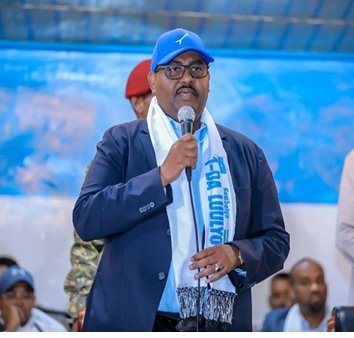
Qardho (WDN)- Since his re-election as President of Puntland, President Said Abdullahi Deni has faced escalating public discontent amid worsening economic conditions, soaring unemployment, rampant corruption and an increasingly unbearable cost of living. At the same time, his administration has been tightening its grip on civic space through the intimidation of journalists, restrictions on independent media, and efforts to silence citizens seeking to peacefully express their opinions and criticism. These developments have fueled growing concerns about democratic backsliding and the weakening of fundamental civil liberties across Puntland.
In a move that has sparked immediate political debate, authorities in Puntland’s Karkaar region have issued an unexpected directive banning hotels, conference halls, and other public venues from hosting press conferences, political meetings, or public gatherings without prior government approval. The order, which was circulated to hotel owners and managers of event facilities across Qardho and the wider Karkaar region, warns that legal action will be taken against any individual or business found violating the directive. The announcement has raised eyebrows because of its timing.
The directive was issued less than 24 hours after an unusual political gathering took place in Qardho involving individuals described as members of Puntland’s opposition and figures believed to maintain close ties with Villa Somalia. Participants at the meeting reportedly expressed support for President Hassan Sheikh Mohamud, a development that surprised many observers given Puntland’s increasingly strained relationship with the Federal Government.
The speed with which regional authorities responded has fueled speculation that the government’s decision was directly linked to the meeting and was intended to prevent similar political mobilization efforts in the future.
For years, Puntland has prided itself on maintaining a relatively open political environment compared to many parts of Somalia. Public forums, political meetings, and consultations among elders, intellectuals, and community leaders have long been a feature of Puntland’s political culture. That is why the latest directive has generated considerable discussion among residents and political observers alike.
This measure is a restriction on freedom of assembly and political expression, particularly if it is selectively enforced against groups perceived to be sympathetic to the Federal Government. Supporters of the decision, however, contend that authorities have a responsibility to monitor public gatherings in order to maintain security and prevent external actors from exploiting political divisions within Puntland. The controversy comes at a particularly sensitive time.
Relations between Puntland and Mogadishu have deteriorated significantly over the past several years amid disagreements over constitutional amendments, power-sharing arrangements, elections, and the future structure of Somalia’s federal system. Against this backdrop, any political activity perceived as advancing the interests of Villa Somalia inside Puntland is likely to attract intense scrutiny.
What has particularly caught the attention of observers is the symbolism of Qardho itself. Often regarded as one of Puntland’s most politically influential cities, developments in Qardho frequently reverberate across the wider region. The appearance of a political gathering openly expressing support for President Hassan Sheikh in a city traditionally associated with strong Puntland political identity was unexpected and immediately became a topic of discussion.
The Karkaar administration has not publicly stated that the new restrictions are connected to the meeting held on the previous day. Nevertheless, the sequence of events has fueled widespread speculation that the two developments are closely related.
Political analysts note that the episode highlights the growing competition for influence between Puntland’s leadership and political actors aligned with the Federal Government. They warn that efforts to restrict political gatherings, regardless of motive, risk deepening polarization at a time when dialogue and political accommodation are needed more than ever.
For now, hotel owners, conference center operators, and community organizations across Karkaar face a new reality: no political gathering, press conference, or public meeting can take place without government knowledge and approval. Whether the directive proves to be a temporary security measure or the beginning of a broader effort to regulate political activity in Puntland remains to be seen. What is already clear, however, is that a single meeting in Qardho has triggered a reaction that few anticipated—and exposed just how sensitive Puntland’s political landscape has become.
WardheerNews