
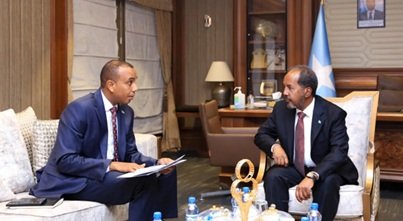
Mogadishu (WDN) — Somalia’s Prime Minister, Hamza Abdi Barre, has drawn a hard line: the government’s term is five years, and “there is no deviation.”
It is a definitive statement. It is also a deeply contested one. Delivered with just weeks remaining before the current mandate is widely understood to expire, the Prime Minister’s position rests on constitutional changes pushed unilaterally under President Hassan Sheikh Mohamud that lack broad political consensus and are rejected outright by Puntland, and Jubaland and the opposition.
That contradiction sits at the heart of Somalia’s unfolding crisis. On paper, the government argues that both the 2012 Provisional Constitution and its recent revisions clearly establish a five-year term. In practice, there is no agreed constitution at all, only a disputed document being asserted as settled law at the very moment it is most politically convenient.
Also, the timing is hard to ignore. With roughly 24 days remaining in the current mandate, the administration is not seeking consensus—it is asserting authority. The same applies to parallel decisions, including the directive that ministers cannot simultaneously serve as members of parliament. While framed as constitutional compliance, opponents see it as selective enforcement: rules activated late, without agreement, and under conditions of political uncertainty.
The Prime Minister described the constitution as “the supreme agreement that unites the country.” But that claim is precisely what is being challenged. For many political actors, there is no such agreement, only a process they view as unilateral, incomplete, and imposed. The gap between assertion and acceptance is where instability begins.
Opposition figures have already rejected the change constitutional framework and continue to insist that the government’s term ends on May 15, 2026. From their perspective, any attempt to extend authority beyond that date—under the cover of contested amendments—risks crossing from governance into overreach.
The Prime Minister’s response has been unequivocal: the government will not accept any position that contradicts its reading of the constitution. But in a system built on negotiation and fragile consensus, refusal to accommodate dissent does not resolve a dispute—it hardens it.
Somalia is drifting toward a familiar fault line: competing legal claims layered over unresolved political divisions. When there is no shared agreement on the rules, every action becomes contested. Every decision becomes political. And every deadline becomes a trigger point.
This is not simply a debate over term limits. It is a test of legitimacy. If constitutional authority is asserted without consensus, it risks losing the very legitimacy it seeks to enforce. And if political actors no longer recognize a common framework, the system itself begins to fragment—quietly at first, then all at once.
Somalia has seen how quickly that slide can happen. The Prime Minister’s message may have been intended to project clarity. Instead, it has exposed the depth of the uncertainty. And with the clock ticking toward May 15, the question is no longer what the constitution says. It is who still believes in it.
WardheerNews