
By Abdullahi A. Nor
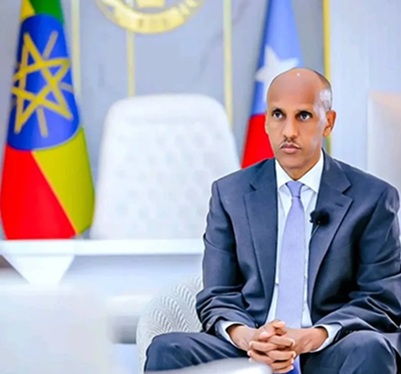
When Mustafe Omer came to power in August, 2018, he represented a break from the past. An activist and outspoken advocate for justice, accountability, and the rights of the Somali people, he was widely seen as the face of a new political era. Nearly eight years later, that promise has given way to a far more troubling question: Has the Somali Regional State become a government for its people—or a political system built around Mustafe Omer and his inner circle, not different from his predecessor Abdi Iley and his ruthless regime?
Where is the institutional reform that was promised? Where are the stronger systems of accountability? What has been done to improve education, healthcare, public utility (water, and electricity), employment, and economic opportunity? And why, after eight years, do so many fundamental governance questions remain unresolved?
Perhaps the most striking feature of Mustafe Omer’s political journey is the distance between the man who entered politics and the leader he has become. In 2018, Mustafe was known primarily as an activist—someone who challenged abuses of power, spoke for marginalized communities, and demanded greater accountability from those in government.
Today, what was presented as a project of reform is not more than the personalization of the state. Political loyalty matters more than institutional independence, access to power is concentrated around those close to President Mustafe and public institutions has become an instruments for protecting political authority rather than serving citizens.
The concern is not simply about one individual. It is about what happens when a government becomes dependent on one person and the network surrounding him. When officials owe their positions to political loyalty, they have little incentive to challenge the leadership. When institutions become extensions of the executive, accountability weakens. And when legitimate and genuine criticism is treated as disloyalty, public debate and freedom of speech begins to disappear. This is precisely why the record of the past eight years deserves much greater scrutiny.
The issue extends beyond governance inside Jigjiga. There are growing concerns about the protection of Somali interests and territory, particularly amid continuing tensions and disputes involving Somali and Oromo areas. Questions surrounding the Oromo expansionist policy in Fafan and Daakhato, together with longstanding memories of Dire Dawa, Jinacsani, Babali, and Moyale, continue to fuel public anxiety, while Mustafe is looking the other way to protect his position and interest.
Reliable reports indicate that Oromia’s territorial ambitions continues across the Somali Region, with Jigjiga, Tuli Guuleed, and other Somali-administered territories, raising serious concerns about the future integrity of Somali-administered territories. The people have a right to ask whether their government is doing enough to protect their territorial, political, and economic interests. Equally troubling is the shrinking space for freedom of speech.
Mustafe built his reputation as an activist and critic of authoritarianism. Yet his administration’s treatment of dissenting voices, journalists, activists, political opponents, and social-media users has been deeply repressive. The government may legitimately act against incitement and violence, but legitimate criticism of those in power cannot simply be recast as a security threat.
A government cannot claim to represent the people while making its critics afraid to speak. And this is where the contradiction in Mustafe’s political journey becomes difficult to ignore: the activist who once challenged concentrated power now presides over a system of concentrating power around himself. The deeper concern is the emergence of a political patronage system—one in which loyalty creates access, access creates influence, and influence protects loyalty. That is how a public institution becomes a personal political network.
Although the Somali Region operates within Ethiopia’s broader authoritarian political system, that reality cannot excuse President Mustafe from responsibility. He still has significant authority within the regional government and could have done far more to protect the interests of the Somali people, strengthen regional institutions, and assert the region’s legitimate political and economic rights. Other regional administrations, including the Oromo regional government, have demonstrated that regional leaders can exercise considerable political space within the federal system. The constraints imposed by Addis Ababa may be real, but they should not become a blanket justification for failing to fulfill the responsibilities of leadership.
The Somali Region is not the property of its president. Its institutions do not belong to his supporters. Its public resources are not the private assets of those close to power. Government is a public trust. After nearly eight years, Mustafe should therefore be judged not by the promises he made when he entered office, but by the institutions he has built, the freedoms he has protected, the resources he has safeguarded, and the opportunities he has created for ordinary Somalis. The state itself has become personalized. And that should concern every Somali in the Somali State, who cares about the Somali region’s future. The Somali Region must belong to its people—not to one man, one clan, or one political circle.
From Activist to Gatekeeper
The transformation from activist to president is not, in itself, a contradiction, Today, Mustafe occupies the very center of power. Activists can become leaders, and leaders can legitimately change their approach once they assume responsibility for governing. The real test, however, is whether the principles that brought them to prominence survive after they acquire power. That is where Mustafe’s record raises difficult questions.
The man who once challenged political gatekeepers is now has become one himself. Instead of opening political space, his administration has increasingly concentrated decision-making around the presidency and a small circle of trusted political allies. Instead of empowering independent institutions, the system appears increasingly dependent on personal loyalty and proximity to power. The irony is difficult to miss: the activist who once demanded that government answer to the people now leads a government that his critics say increasingly expects the people to answer to it.
This transformation matters because political power changes the relationship between the individual and the state. As an activist, Mustafe could challenge the government from outside. As president, he controls—or exercises substantial influence over—the institutions that shape political life inside the region. That places a far greater responsibility on him to protect the very freedoms and institutional safeguards that he once demanded from others.
The question is therefore not whether Mustafe has changed. Every leader changes. The question is what happened to the principles he once represented? Where is the uncompromising commitment to accountability and public service? Where is the insistence that public institutions must serve citizens rather than political interests? Where is the protection of dissenting voices? Where is the conviction that government must be subject to scrutiny rather than scrutiny being treated as a threat?
A political system should not require citizens to be loyal to those in power. Leaders should be accountable to citizens. That distinction is fundamental. When an activist becomes a gatekeeper, the danger is not merely personal contradiction. It is institutional. The same individual who once fought to open the doors of government can, once inside, end up deciding who gets access, who gets heard, who gets appointed, and who is pushed outside the political system. That is why Mustafe Omer’s greatest test is no longer whether he can retain power. It is whether he can prevent power from becoming the organizing principle of the state itself.
After nearly eight years, the Somali people deserve an answer not speeches or political slogans, but from the institutions that surround them and the freedoms they are allowed to exercise. A reformer is ultimately defined not by how fiercely he challenges power before acquiring it, but by how willing he is to restrain power after acquiring it.
Abdullahi A. Nor
Email: abdulahinor231@gmail.com
Leave a Reply