
By Mohamed Abdiqafar Haji Hussein
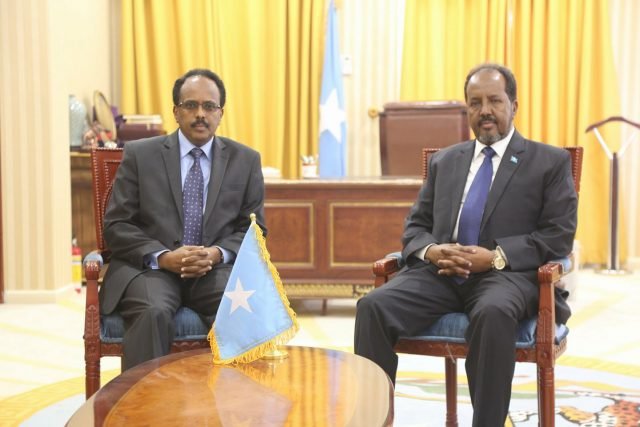
President Hassan Sheikh Mohamud was elected at a time when Somalis were largely united and eager to turn a new page. The May 2022 presidential election, however, followed a prolonged and bitter political standoff. Former President Mohamed Abdullahi Farmaajo was widely suspected of attempting to consolidate power by extending his term for two additional years. His justification was that the next election would be based on one-person-one-vote.
As the election unfolded, Somali politics became sharply divided: President Farmaajo on one side, and almost all other presidential candidates and most of the other stakeholders on the other. At that time, the Somali people were united around one issue: never again accepting another dictator to rule Somalia. The former President Farmaajo reminded Somalis how easily a president could once again attempt to centralize power. That reminder was the main reason many Somalis turned against him at the last minute—it exposed how quickly history could repeat itself.
President Hassan Sheikh was among those who accused President Farmaajo’s plan of being dictatorial and urged the Somali people to oppose him. No one expected that any of the candidates would attempt to repeat the same mistake Farmaajo has made. For the first time in a long while, Somalis believed they finally knew the path forward. Eventually, Hassan Sheikh Mohamud was elected president. During his campaign, he promised to lead a Somalia that would be at peace with itself and with the international community. That message, combined with his prior experience as president, convinced many Somalis that he was the right person to reunite the country—if he stayed true to his word.
However, almost immediately after his election, President Hassan appeared to change course. He quickly retreated to his political circle and focused on forming a government dominated by his allies. Many of the candidates who had worked tirelessly to ensure his victory were sidelined. Power began to concentrate in the presidency once again. He appointed a prime minister widely viewed as taking direction solely from the president. This was a wrong turn and the first opportunity missed.
The path expected of President Hassan was clear. He knew that Somalia’s provisional constitution remains incomplete. He also knew that the country cannot move forward unless that constitution is finalized through broad national consensus. No single group, party, or administration can complete the constitution alone. President Hassan had already witnessed how President Farmaajo’s unilateral attempt to alter the constitution ultimately failed.
With all this knowledge, Somalis expected President Hassan to form a genuine government of national unity. They expected him to bring all stakeholders to the table—including President Farmaajo—and clearly state that Somalia’s priority must be finalizing the constitution and establishing a credible one-person-one-vote system within a defined time frame. Many believed that President Hassan, now serving a second term, should have committed himself to completing these foundational tasks without seeking another term, allowing the next president to govern with a clear and legitimate mandate. Had he taken that route, Somalia would be in a very different place today.
Instead, President Hassan repeated the same mistake as his predecessor by assuming that he held a mandate comparable to presidents elected in fully constitutional democracies. Both Presidents Farmaajo and Hassan Sheikh Mohamud overlooked a critical reality: they were elected under an unfinished constitution. Their authority to act unilaterally—especially on constitutional and electoral matters—has always been questionable.
As President Hassan’s term neared its final months, there was still no agreed-upon electoral process. He insisted that a one-person-one-vote election would take place on May 15, 2026, despite changes made to the constitution without broad consensus. Most opposition groups rejected both the constitutional changes and the proposed election process. A major opposition meeting was later held in Kismayo, and attended by most opposition leaders. The final communiqué called on the president to return to negotiations and agree on an inclusive and acceptable electoral framework. There were even reports that if the president refused, the opposition would organize a parallel election elsewhere.
Amid this political uncertainty, Israel announced its recognition of Somaliland as an independent state. The Somali federal government immediately protested, and many countries and international organizations reaffirmed their support for Somalia’s sovereignty and territorial integrity. At that moment, President Hassan had a clear opportunity to unite the country.
The steps required were simple. He should have immediately convened all opposition leaders and declared that Somalia’s sovereignty was under attack, and that national unity was the only defense. He should have acknowledged the legitimacy of opposition concerns regarding constitutional changes and the election process, pledged to suspend unilateral actions, and committed to negotiations toward a mutually agreed framework. Once Somalia spoke with one voice, serious dialogue with Somaliland could have begun.
Instead, the president continued pushing forward as if opposition and Somaliland could both be ignored. He appeared to believe that international support for Somalia’s sovereignty made domestic consensus unnecessary. On several occasions, President Hassan argued that international law and African Union principles prohibit interference in internal affairs, and therefore Somaliland’s recognition would never succeed. This reasoning led him to dismiss the need for dialogue with Somaliland.
Many Somalis believe that Somaliland sought recognition Isreal at this time because it felt increasingly cornered. Policies such as mandatory e-visas, a $60 federal visa fee imposed without consultation, reports of centralized control over ports, and proposals to route all international flights through Mogadishu reinforced that perception.
At the same time, opposition groups were ignored. The President is still speaking from Villa Somalia as if business is usual. Nothing in his speech has changed from what he used to say before all this happened. He continues to talk about a way out of the crisis—one that follows the path he alone envisioned. He lists achievements he believes were accomplished without opposition or Somaliland’s involvement. Because the international community recognizes his government like any other in the world, he sees no need for consensus. What he ignores is that the constitution under which he was elected remains incomplete and, by its very nature, must be finalized through a consensual process.This was the second major opportunity President Hassan missed.
Yet there is still a chance. President Hassan must call a meeting with all other stakeholders to discuss the issues at hand: Somali sovereignty under attack and the absence of an agreed-upon framework for the upcoming election. These are two issues he must address immediately. Most important is recognizing that the President can protect Somali sovereignty only when there is a unified front. When Somalis are divided, achieving that goal becomes far more difficult, as adversaries gain opportunities to distract and undermine the national agenda.
Once an agreement is reached on the upcoming election, the next step should be direct engagement with Somaliland to open dialogue. Any other path the President chooses will lead to disaster. At the moment, he appears inclined to proceed with an election based on his own vision and to assume that international support is sufficient to manage the Somaliland issue. But the only lasting solution is one reached among Somalis themselves.
Mohamed Abdiqafar Haji Hussein
Email: mohabdhus@gmail.com
Atlanta , Georgia.