
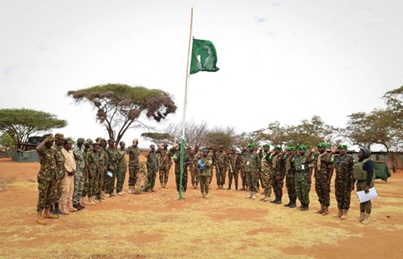
Mogadishu (WDN) — The African Union Support and Stabilization Mission in Somalia (AUSSOM) is preparing to withdraw from Somalia by December 31, 2026, yet the country remains unprepared to fill the security and stabilization vacuum its departure could create. Somalia’s security forces still face significant capacity and coordination challenges, while political divisions continue to undermine national cohesion.
A new map published by the Belqees Center for Studies has laid bare the extraordinary scale of the African Union’s security presence in Somalia, revealing that AUSSOM forces are spread across 56 military bases in five major operational sectors.
According to data presented by the research center, Uganda maintains the largest number of military bases, with 22, followed by Ethiopia with 15, Kenya with eight, Djibouti with six, and Burundi with five.
Taken together, the deployment represents an estimated 11,826 African Union personnel stationed across Somalia, underscoring just how heavily the country’s security architecture continues to depend on foreign forces more than three decades after the collapse of the Somali state.
The figures provide a striking visual reminder of the scale of the challenge facing Somalia: despite years of international military assistance and repeated offensives against Al-Shabaab, thousands of African troops remain deployed across the country to support Somali forces and protect key strategic locations.
A Security Mission Built on International Support
AUSSOM’s operations depend heavily on international logistical and financial support, particularly through the United Nations Support Office in Somalia (UNSOS).
That support encompasses a wide range of essential services, including transportation, supplies, logistics, communications, medical evacuation and other operational requirements without which maintaining such a geographically dispersed force would be extraordinarily difficult. But that support system is now facing a potentially disruptive turning point.
The United States has decided that it will not continue supporting UNSOS beyond 31 December 2026, raising serious questions about how AUSSOM will sustain its current operations and whether the mission can maintain its existing footprint. The implications could be profound.
‘No Time to Drift’
In its report, titled “No Time to Drift,” the Belqees Center warns that the end of 2026 could place Somalia at a particularly sensitive security crossroads unless a credible transition strategy is put in place.
The center is calling for a structured and carefully sequenced plan to transfer security responsibilities progressively to the Somali National Army and other national security institutions.
The objective is clear: prevent a security vacuum from emerging as African forces reduce their presence and international financial and logistical support declines. The warning comes at a critical moment for Somalia.
Although Somali security forces have expanded their capabilities in recent years, they have not yet demonstrated the capacity to assume every responsibility currently carried by AUSSOM across the country’s vast and difficult operating environment.
Three Questions Will Define AUSSOM’s Future
According to the Belqees Center, the future of the mission will largely depend on three interconnected factors. First, funding. AUSSOM will require predictable and sustainable international financing if it is to maintain its operations during the transition.
Second, logistics. The continued availability of transportation, communications, medical evacuation, supplies and other operational support will be essential to keeping the mission functioning.
Third, Somali capacity. The Somali security forces must be prepared to assume responsibilities gradually and sustainably rather than being forced into an abrupt takeover for which they may not yet be adequately prepared.
These challenges expose a fundamental contradiction at the heart of Somalia’s security transition. The country is expected to take increasing responsibility for its own security, yet the international forces supporting that transition remain essential to maintaining stability in many parts of the country.
A Dangerous Transition
The Belqees Center warns that a sudden decline in international funding or logistical assistance could place enormous pressure on both AUSSOM and the Somali government’s ability to confront continuing security threats. For Somalia, the stakes could hardly be higher.
A premature reduction in international support could create vulnerabilities that Al-Shabaab would be quick to exploit. Conversely, an indefinite dependence on foreign forces is neither financially sustainable nor compatible with Somalia’s long-term objective of building a genuinely sovereign national security architecture.
The challenge, therefore, is not simply how to end AUSSOM. It is how to replace it without creating a vacuum. With 56 bases, nearly 12,000 African troops and an operational structure heavily dependent on international support, the scale of Somalia’s security dependence has rarely been more visible.
As the December 2026 deadline approaches, Mogadishu and its international partners face an increasingly urgent question: Can Somalia build the capacity to secure itself before the international system that has been carrying much of that burden begins to disappear?
WardheerNews