
As competing powers reposition across the Red Sea and Horn of Africa, an Israeli security presentation highlights shifting strategic calculations—and the growing risk that Somalia’s internal divisions will become entangled in wider regional rivalries.
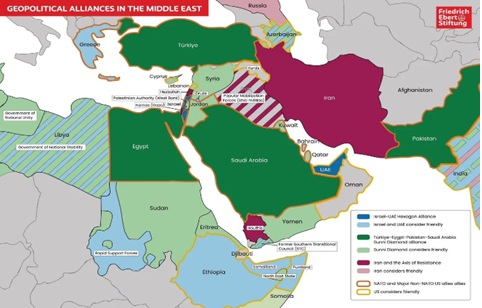
JERUSALEM (WDN) — A geopolitical map displayed behind Israeli Prime Minister Benjamin Netanyahu during a national security presentation on Sunday has placed Puntland and Somaliland in a category considered friendly to Israel and the United Arab Emirates (UAE), while Somalia and the North East State appear in a rival grouping associated with Türkiye, Egypt, Saudi Arabia and Pakistan.
The map offers a striking illustration of how the Horn of Africa is increasingly being viewed through the lens of a wider strategic contest stretching from the Middle East to the Gulf of Aden and the Red Sea. It also raises difficult questions about how Somalia’s internal political divisions may intersect with the ambitions of powerful regional actors.
But an important distinction must be made: the map is not proof that Puntland has entered a formal alliance with Israel, nor does its classification constitute diplomatic recognition. Created by researchers Marc Saxer and Marcus Schneider and published by Germany’s Friedrich-Ebert-Stiftung in May 2026, it presents an analytical interpretation of emerging geopolitical alignments. Its appearance during Netanyahu’s presentation gives it political significance, but does not turn every category into a formal diplomatic commitment.
Two Competing Strategic Visions
The map depicts what its authors describe as a potential Israel-UAE-centered partnership, referred to as the “Hexagon alliance,” alongside a countervailing grouping of Türkiye, Egypt, Saudi Arabia and Pakistan, labelled the “Sunni Diamond.”
The emerging alignments reflect competing calculations over regional influence, security and access to strategically important maritime routes. They are not necessarily rigid blocs: states may cooperate on one issue while disagreeing on another, and their relationships can change as national interests evolve.
Netanyahu’s presentation nevertheless suggests that Israel intends to capitalize on this shifting environment. According to reports of his remarks, he wants to use the remaining two years of US President Donald Trump’s administration to expand Israel’s network of partnerships and strengthen its regional position.
For Israel and the UAE, the Horn of Africa offers strategic value beyond its geography. Its coastline overlooks some of the world’s most important shipping routes, including the Bab el-Mandeb Strait, which connects the Gulf of Aden with the Red Sea. Ports, maritime security arrangements and relationships with local authorities can therefore carry significance far beyond the territories in which they are based.
For Türkiye, Egypt and Saudi Arabia, the region is equally important because of its proximity to the Red Sea, their security interests and their relationships with governments across the Horn of Africa.
The result is a more complicated regional landscape in which local political disputes can become linked to the calculations of external powers.
Somalia’s Internal Divisions Enter the Picture
The map’s treatment of Somalia is particularly sensitive. Puntland and Somaliland are placed in the Israel-UAE-friendly category, while the territory labelled Somalia and the separately identified North East State appear in the opposing grouping.
These classifications should not be interpreted as evidence that Puntland has formally aligned itself with Israel. Puntland has maintained significant economic and security ties with the UAE, while its relationship with Mogadishu has been strained by disputes over federal authority and agreements with foreign partners. Those relationships may help explain the mapmakers’ assessment, but they do not establish a formal Puntland-Israel alliance.
Somaliland’s position is different. Israel formally recognized Somaliland in December 2025, a decision rejected by Somalia’s Federal Government. The map’s depiction of the North East State as a separate territory also intersects with longstanding disputes over territorial claims and political authority in the north. The graphic does not, by itself, establish Israel’s definitive position on every disputed boundary.
For Mogadishu, the broader concern is that Somalia’s internal disagreements could become more deeply entangled in foreign competition. Türkiye has developed extensive defense and security cooperation with the Federal Government, while the UAE maintains important relationships with Puntland, Somaliland and other regional actors. Chatham House has warned that the interaction between Somalia’s domestic political crisis and external rivalries creates a serious risk of further instability.
The danger is not that every relationship automatically produces confrontation. It is that political leaders may increasingly seek foreign support to strengthen their domestic positions, while outside powers pursue strategic objectives through their local partnerships.
A Map Is Not a Treaty—but the Signal Matters
The map should neither be dismissed as meaningless nor mistaken for an official alliance agreement. Its significance lies in the strategic assumptions it reveals: some Somali territories are being viewed as potential partners in one regional configuration, while others are associated with a competing set of powers.
That perception matters because foreign policy decisions are shaped not only by formal treaties but also by security cooperation, port investments, diplomatic recognition and access to strategic infrastructure.
For Somalia, the challenge is to prevent domestic political fragmentation from becoming a channel through which regional competition deepens its divisions. For Puntland and Somaliland, being viewed as strategically valuable may create opportunities for external engagement, but it may also expose them to pressures arising from conflicts and rivalries beyond their control.
The Federal Government faces a parallel challenge: maintaining constructive relations with its international partners while addressing disputes with regional administrations through political dialogue rather than allowing them to harden into competing foreign-policy camps.
The central lesson is that Somalia’s political divisions no longer exist in isolation from the wider geopolitical contest surrounding the Red Sea.
Netanyahu’s map does not prove that a new regional war is inevitable, nor does it establish that the countries shown in each color will act as a unified bloc. But it provides a revealing snapshot of how influential strategic circles are interpreting the changing balance of power.
As alliances shift and competition intensifies, Somalia’s leaders must recognize that decisions taken in Mogadishu, Garowe and Hargeisa can carry consequences far beyond the country’s borders.
In an unsettled geopolitical environment, the greatest danger may not be the existence of competing alliances, but the failure to manage them without allowing Somalia’s own political disagreements to become instruments of a wider struggle for regional influence.
WardheerNews
Leave a Reply