
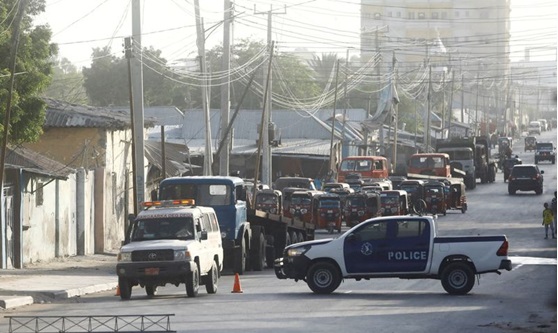
Mogadishu (WDN) – A new security operation launched by the Banadir Regional Police Command to recover illegal weapons from neighborhoods across Mogadishu is exposing a deeper and more troubling challenge facing Somalia’s capital: a widening crisis of public trust between citizens and state security institutions.
Police officials announced that a large-scale operation is underway to collect unlicensed firearms believed to be hidden in various districts of Mogadishu following recent armed confrontations in the Abdulaziz and Hawlwadaag districts. Banadir Police Commander Mahdi Omar Mumin said security forces have begun searches in several parts of the city where significant quantities of weapons are suspected to be stored.
“The operation is part of ongoing efforts to strengthen security and prevent further instability in the capital,” the commander said. However, the announcement has been met with skepticism and concern among many residents, particularly in neighborhoods that have recently witnessed political tensions and armed clashes.
For a significant number of Mogadishu residents, the issue is no longer simply about disarmament. It is about who is being disarmed, who is conducting the operation, and whether the law will be applied equally.
Many residents interviewed by local media and community sources expressed fears that the campaign could be perceived as targeting specific communities or areas associated with prominent opposition figures. Such perceptions, whether accurate or not, risk undermining public cooperation with security institutions and could increase tensions at a time when the city remains politically polarized.
“The challenge is not the principle of disarmament,” said one political observer in Mogadishu. “The challenge is confidence. If citizens believe the law is being enforced selectively, then even legitimate security operations become controversial.”
Mogadishu remains one of the most heavily armed cities in the region. Decades of conflict, weak institutions, and recurring political crises have left many communities reliant on armed self-protection. As a result, attempts to remove weapons from civilian hands often encounter resistance unless accompanied by broad political consensus and public confidence.
Police have urged residents of Abdulaziz, Hawlwadaag, and surrounding districts to cooperate with security agencies and assist efforts to improve public safety. Yet many citizens remain cautious. Some residents argue that trust in government institutions has eroded due to ongoing political disputes and allegations of partisan use of state power. Others fear that surrendering weapons without broader security guarantees could leave communities vulnerable in an uncertain political environment.
The police command also issued a stern warning that anyone found in possession of illegal weapons would face legal consequences. While authorities describe the warning as a necessary law-enforcement measure, some residents view it through a political lens, reflecting the deep divisions that currently characterize Somalia’s political landscape.
Security analysts warn that the success of any disarmament campaign will ultimately depend not only on the capacity of security forces but also on public confidence in their neutrality. “Disarmament requires legitimacy,” one security analyst said. “People are far more willing to cooperate when they believe security institutions serve the nation rather than any particular political faction.”
The current operation therefore highlights a broader challenge confronting Somalia’s leadership: rebuilding trust in state institutions at a time of heightened political tension. As Mogadishu struggles to recover from recent clashes and political uncertainty, many observers argue that restoring confidence between citizens and security forces may prove just as important as recovering weapons from the streets.
WardheerNews