

By Abdiqani Haji Abdi
Within the span of 48 hours, the administrations of South West State and Galmudug launched highly publicized voter registration campaigns for the proposed one-person, one-vote elections. Though marketed as milestones in Somalia’s democratic journey, analysts and political observers view these launches as hollow exercises, marred by expired mandates, territorial insecurity, and a broader strategy orchestrated by Villa Somalia to divert attention from a key opposition consultation taking place in Mogadishu today.
In Baidoa, South West State President Abdiaziz Hassan Mohamed Laftagareen—whose constitutional mandate expired long ago—oversaw a ceremonial launch of the voter registration process on July 2. A similar event followed on July 3 in Dhuusamareeb, where Ahmed Abdi Kariye (Qoor Qoor), also operating without a legitimate mandate, registered himself as the first voter in Galmudug.
Both men, who critics now refer to as “puppet presidents” under Villa Somalia’s command, appear to be executing political theatre on behalf of President Hassan Sheikh Mohamud, who faces increasing scrutiny over his administration’s handling of constitutional reform and federal-state relations. Political insiders suggest the timing was deliberate, intended to undermine a major consultation meeting between Villa Somalia and opposition figures.
“This is not a step toward democracy. It’s a PR stunt—a staged distraction ordered by the presidency to drown out more legitimate political discourse,” said a senior political analyst in Mogadishu.
Security Realities Undermine Credibility
While President Laftagareen lauded the launch in Baidoa as a “new chapter in democratic governance,” Many ordinary citizens and critics were quick to point out the disconnect between the rhetoric and on-the-ground realities. For over 15 years, most districts in South West State have been under siege by Al-Shabaab, with no road access and air travel as the only lifeline. The same applies to Galmudug, where significant swaths of territory remain under insurgent control, making it virtually impossible to conduct free, fair, or secure voter registration or elections.
“With large areas classified as no-go zones, there can be no meaningful voter outreach, no safe registration teams, and no viable polling infrastructure,” said an independent election observer. “It’s propaganda masquerading as progress.”
In Galmudug, observers also noted the launch lacked logistical depth, and no tangible preparations appeared to be in place to carry out the registration beyond the president’s symbolic gesture. Similarly, in South West State, community members have expressed concern that the process is exclusionary, lacking transparency and real local participation.
Mandate Expiry and Presidential Overreach
Both Laftagareen and Qoorqoor are ruling without constitutional mandates, with their terms long expired and no clear roadmap for legitimate succession. Their continued presence in office is widely seen as a political convenience for Villa Somalia, allowing the federal government to exert control over federal member states through loyalists rather than elected leaders.
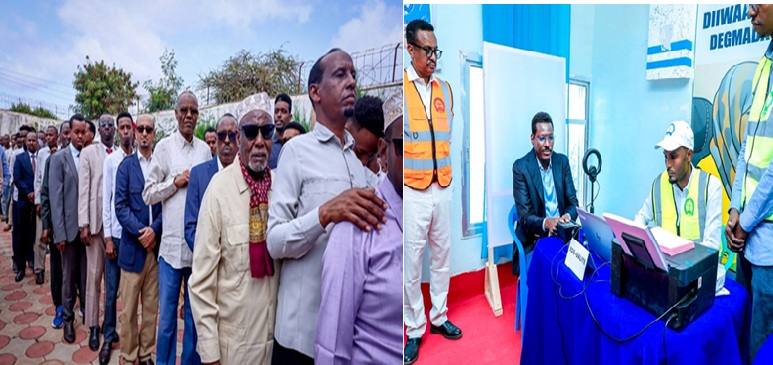
Opposition leaders accuse President Hassan Sheikh Mohamud of using these two figures as “dogs of war” to serve federal political interests at the expense of genuine state-level autonomy and democratic integrity.
“There is no constitutional or moral authority left in either of these two administrations,” one former minister remarked. “What we’re seeing are political marionettes executing orders to manufacture legitimacy where there is none.”
The contrast with the ongoing opposition consultation meeting in Mogadishu is stark. That meeting, attended by independent politicians, civil society leaders, and legal experts, aims to address critical national issues such as the expired mandates of federal member state presidents, electoral accountability, and the increasing centralization of power in Villa Somalia.
Yet instead of engaging with these demands, the federal government appears to have instructed parallel events to dominate headlines and project an illusion of progress.
Democracy in Name Only
Though the banners read “One-Person, One-Vote,” these campaigns represent little more than vanity projects, designed to appease international partners and suppress domestic dissent.
The Independent National Electoral Commission unitarily established by President Hassan has yet to confirm any operational framework, funding mechanisms, or timelines for actual elections in either state. There is also no clarity on how registration will be verified in territories where the government has no presence.
“It’s the shell of a process, not the substance,” said a constitutional lawyer in Garowe. “This is mock democracy. Without legitimacy, security, and transparency, these exercises amount to electoral fraud in slow motion.”
A Fragile Federation at Risk
As the federal government continues to push controversial constitutional amendments and consolidate authority, the trust deficit between Villa Somalia and the federal member states deepens. Puntland and Jubaland—both of which have rejected the recent constitutional changes—have opted out of participating in what they describe as “federally engineered chaos.”
The latest moves by South West State and Galmudug risk exacerbating political fragmentation and may set a dangerous precedent for token elections without real accountability.
A Nation Drifting
Somalia stands at a dangerous crossroads. The illusion of progress, manufactured through symbolic voter registration ceremonies, cannot mask the deeper structural problems facing the federation. As opposition voices continue to demand genuine reform and accountability, attempts to overwrite them with state-sponsored spectacles only widen the gulf between people and power.
Until Somalia confronts the real questions of legitimacy, security, and federal integrity, no ballot—symbolic or otherwise—will move the country forward.
Abdiqani Haji Abdi
Email: Hajiabdi0128@gmail.com