
TheAviationist
As the Truman CSG returns home, a huge airstrike against ISIS targets in Somalia was revealed, involving at least 16 F/A-18s and 125,000 lb of munitions.
Before the commencement of Operation Rough Rider, which saw an intensified campaign of strikes against Houthi targets in Yemen, the USS Harry S. Truman launched a massive sortie against leadership elements of the ISIS terror group in Somalia. At the time, some limited mentions of this operation trickled into the public domain but were light on details regarding the scale of the mission.
On Monday, May 19, 2025, acting U.S. Chief of Naval Operations Admiral James Kilby detailed various aspects of the Truman’s deployment during a discussion panel at the Council for Foreign Relations. These details, spotted by Paul McLeary of Politico, covered the Truman’s participation in shielding U.S. and allied forces from Houthi strikes, counter-strikes on the Houthis themselves, as well as the operation in Somalia.
Kilby described the Feb. 1 Somalia mission, which was conducted in cooperation with the internationally recognized Somalian government, as the “largest airstrike in the history of the world” from a single aircraft carrier. Totaling 125,000 lb of weapons, the mission targeted ISIS-Somalia leadership sheltering in a cave complex in Northern Somalia. Among the 14 members of the group killed was Ahmed Maeleninine, an Omani-born ISIS recruiter and financier who was the primary target of the strike.
Subsequent investigation by Business Insider gleaned from an unnamed U.S. defense official revealed that around 16 F/A-18 Super Hornets took part in the ‘bombing run’. Whether this solely refers to aircraft which directly took part and dropped weapons, or also includes aircraft acting in a support role, is unclear – though the amount of weaponry involved would suggest the former is possible.
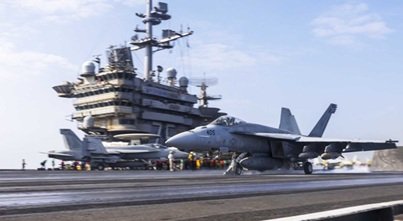
Imagery released on the Defense Visual Information Distribution Service (DVIDS) showing F/A-18 Super Hornet operations on Feb. 1 depicts a number of aircraft launching with live weapon payloads as well as F/A-18F Super Hornets configured as tanker aircraft. The primary role of these carrier-based tankers is to support recovery operations, preventing returning aircraft from needing to ditch with a low fuel state before a slot for their landing back on the carrier can be cleared. Though not as capable as a dedicated tanker in providing extended range to strike missions, they can also be used in a limited capacity in that role.
The strike did seemingly receive refueling support from at least one U.S. Air Force KC-135R Stratotanker, using a boom drogue adapter (BDA) to convert the aircraft’s flying boom refueling system to an F/A-18 compatible hose and drogue. Some KC-135s are equipped with Multi-Point Refueling System (MPRS) pods on each wing to allow refueling of refueling probe-equipped aircraft without the need for an adapter. The downside of using the adapter is that while it is fitted (a task completed by ground crews), the aircraft cannot be used to refuel aircraft fitted for the flying boom system.
For a brief period, the KC-135 apparently involved was tracked by Flightradar24.com using multilateration. While this means the track may not be 100% accurate, it at least confirms the general operating area.
Other support assets, like E-2D Hawkeyes and EA-18G Growlers, were also potentially employed during the operation. While the threat from hostile anti-air over Somalia is minimal, compared to the skies over Yemen, the Growler may have been used as a precautionary measure. Meanwhile, the E-2D Hawkeye would have focused on the command and control part of its mission, essentially providing a type of air traffic control service to the various aircraft involved in the strike and relaying its radar picture back to the carrier group.
Weapons shown by released imagery reinforce the notion of a much reduced anti-air threat over Somalia, entirely comprising Mark 80 series bombs fitted with Joint Direct Attack Munition (JDAM) guidance kits rather than the advanced glide bombs and standoff munitions frequently employed over Yemen. Video footage, released on DVIDS, from the Truman’s hangar show an extraordinary amount of JDAMs being readied for transport up to the flight deck ready to be loaded onto waiting aircraft.
Truman and the Houthis
Admiral Kilby, speaking at the same CFR event, said the USS Harry S. Truman had conducted 670 individual strikes on Houthi targets in Yemen. The carrier strike group had also intercepted 160 missiles and drones launched by the Houthis against U.S., allied, and civilian targets.
Over the course of the deployment, the Truman strike group operated on behalf of three separate combatant commanders – likely those from U.S. Central Command (CENTCOM), U.S. European Command (EUCOM, and U.S. Africa Command (AFRICOM).
Read more: Mass U.S. Airstrike Against ISIS in Somalia Launched from USS Harry S. Truman in February
Source: TheAviationist