
By Dr. Abdulkadir Osman Farah
“Xudduntii dhulkaygaay, Xaruntii dadkaygaay, Xamareey ma nabad baa? Xiddigtii bahdeediyo, Xubnaheeda kala maqan u ahayd xusuustee, Sumaddooda xaynkiyo, Shanta gees u xidhataay. Laamaha xorriyaddiyo, Xayn-daabka calankee, Xejinaaya dhalashada, Xididkay ka beermaan, Xinjir laga waraabshaay”
Maxamed Ibrahim Haraawi (The late Somali Poet and Intellectual)
“In Xamar (Mogadishu) in 1950s and up to1960, for cultural performance, we often imitated Indian and other foreign lyrics and compositions. Then following Somali independence, our brethren “walaalaha Hargeysa” came to Mogadishu. People like Cabdillaahi Qarshe, Cali Sugulle, Cumar Dhuule, Singub, Maandeeq and others. Encouraging us the establishment of comprehensive Somali art. Then the revolutionary state formed a national institution for elite artists “Waabari.” Bringing together northern and southern artists, making us stronger and respected around the world.”
Axmed Naaji Sacad, the late legendry Somali multi-artist composer (Interview with Somali Universal TV)
Political exchange
Once, an elder, sensing time for potential departure, convened his children. He asked each of them to bring a stick. Then he instructed them individually to break it. They easily did. Then he asked them to entangle the sticks together and told them to break them now. They could not. Then, the curious ones inquired “What does this mean.” The elder responded “You are the sticks.”
Recently WardheerNews published an interesting political exchange between two educated politicians, Dr Abdifatah Ismael Tahir, and Abdirashid Hashi. Both politicians care about the struggling/suffering Somali society and their long-term search for peace and prosperity. Their exchange is both insightful and respectful. As a former parliamentarian and a former Minister respectively, the two qualify to engage such detailed discussion of recent Somali politics. In addition, both gentlemen support Somali unity. Abdifatah prefers concrete top-down policy compensation and leadership concessions for decades long exclusion of the North. Meanwhile Abdirashid highlights northern misfortune results from misguided northern policy making. The two also implicitly start opening a potential Somali prospect built on dialogue, reconciliation, and unity.
A world in which Somalis expand politics from its current elitism/oligarchism towards the incorporations of the millions of Somalis for whom the North-South distinction/distrust remains superficial. A world with not just vertical political emphasis but also one with more horizontal national cohesion. If politicians, and the wider society in general, sidestep/undermine unity among Somalis regardless of region and background, Somalis risk becoming a failed internally divided fragmented society/nation. And externally a society/nation that no other nation/society will even bother- notice- their presence/existence, let alone associate or care about them.
The Missing Link
Analysis of Somali politics often misses the observation of Somali realities beyond the current narrow power-elite accumulation/distortion. Most Somalis belong to struggling/suffering communities. People, often busy with daily surviving routines. Constituencies whose potential mobilization and engagement eventually determine not just how the North eventually reconciles with the South, but also how the society and country advances. This middle ground, the awakening of these communities (workers, students, businesspeople, neighbors, academics, sports people, artists, religious movements, and others) collectively project transformative politics. So far, such communities privately combine ascribed kinship relations (identities they have not actively chosen, such as in which family or region to be born/belong to) with acquired identities they access through education, work, and other merit related efforts).
In addition, such diverse Somali communities currently distrust and expect less from Somali politicians/authorities/governments- whether national or regional. This has to do with politicians/ elites not directly connecting with or serving the public. For instance, in repetitive public discourses, one hears the average Somali saying “madax iyo siyaasiyiin fiican allaha na siiyo” (May Allah give us sincere leaders and politicians). So far, therefore, most Somalis remain spectators/passive on raging political trajectories both in the North, in the South and in between. Politics in Somalia circles around elitist (factional) maneuvering and counter-maneuvering.
One such elitist political maneuvering is the persistence of North versus South friction. For most Somalis, such geopolitical division appears a fictive binary. A top-down process, driven by political elites in combination/support with external foreign forces. Consequently, millions of Somalis feel caught up in this so far avoidable senseless/aimless political strife. These include millions, who following independence and with the establishment of national integration programs/policies, moved from the North to the South or from the South to the North. Millions who through education, upbringing, professional jobs, and business enterprises moved from both sides North-South and South-North. Not to mention the millions who settled in the North for sanctuary and shelter escaping from brutal warlord driven disasters and conflicts in the South.
The rise of independent Somali nation
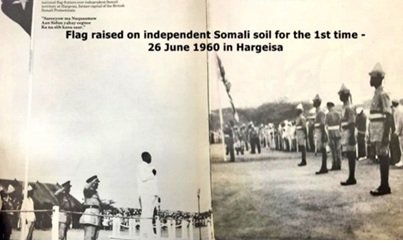
In one simple story among millions of life-determining Somali journeys, my father moved from North to South. As an enthusiastic young man, around 17-18 years old- unhappy with the traditional lifestyle in Sanaag, he joined an army recruitment opening in the Northern city of Burco, sometime 1940s. Once, my father recollected the exceptional historic context and public mood during the event of Somali independence and the raising the Somali flag in Hargeysa, 26th of June 1960. He remarked
It was a tense, hopeful and stressful time, indescribably joyous and celebratory for over half of the people of the town at the time, and uncertainty and unpredictability for a small minority in the city.” At that fateful night, as a soldier my father observed a task in Somali army terms called “Heegan.” In the city, the public celebrated for Somalis finally liberating themselves from colonial subjugation. Free to rule and structure their future as a united Somali society/nation.
For the unhappy part, privileged Somalis through their association of colonial structures and wealth distributions, the drastic restructuring of the society made them restless. Cabdullaahi Suldaan Timacadde poetically captured the significance of the historic event “Sarreeyow ma nusqaamow, aan siduu yahay eegnee, kaana siib kanna Saar.” Boobe Yuusuf Ducaale, a veteran Somali journalist and intellectual in his book (Timacadde, 1983, 2006) writes; “Kaana siib” means distancing, removing, dismissing, and isolating the British flag, “kanna saar” means bringing closer and lifting upwards the remarkable blue Somali flag with the white star”.
On behalf of the Somalis, Timacadde not just marks the glory and the beauty of the Somali flag but also the distance and the gap between arrogant oppressive British colony confronted by Somali quest for justice and liberty. Similarly, few years earlier, expressing the deep Somali dissatisfaction with British colonialism, Abwaan Barkhad Cas decries “Ninkaa araggiisa uurkaan ka necbee, aan ooyee albaabka ii xira.”
Soon after independence, following programs of national integration, northerners, including my father, joined the public ordained transfer of Somali workers and officials to the South. The new state stationed my father in army bases in Baydhabo. Later, late in 1960s, he accepted a transfer to Mogadishu. In 1964, while still in Baydhabo, the state urgently dispatched my father and his battalion to the war breaking up between Imperial Ethiopia and the newly independent Somalia. For the Somalis, the 1964 war, was historically uplifting and successful. In an interview with the BBC, the late decorated General Mohamed Ali Samatar, then a leading top commander of the battle, described the conflict as “the war in which the patriotic Somali army forced the then “lion of Africa” (libaaxa Afrika) to become “the cat of Africa” (bisadda Afrika).”
Around the same time, northerners returned from diaspora- from Yemen (including Hadraawi, Hudeydi and others), East Africa and even all the way from Europe and America with the aim of supporting and contributing to the mobilized Somali national and state development. Consequently, generations of northerners were born, raised, and educated in the South. Similarly, northern elites started and advanced their educational and professional careers in the South. During 1960s to early1980s, northerners, together with their southern brethren, built a strong Somalia that became known and respected around the world. With these enthusiastic generations, Somalia advanced not just internally but also contributed to the liberation and development of other countries in Africa and beyond, including South Africa.
From elitist North-South frictions towards Somali solidarities/cooperation
Conceptually, the Somali North-South binary is not much different from other North-South frictions and conflicts. Ibn-Khaldun considered such geographical distinction highly significant for society and state formation. If not, however, managed thoughtfully and wisely, such differences create serious social and political pathologies with perpetual underdevelopment. The issue is not just geographical solidarity or lack of social, cultural, and political affinities. Ibn-Khaldun suggests that people of the interior of the society (often northerners) demonstrate increased “assabiya” (kinship group feeling and solidarity). People with nomadic backgrounds scattering in the land. Meanwhile, the sedentary part of the society (the South) remains mostly diverse and urbanized demonstrating lesser “assabiya” group feeling. Nomads often act assertively following their internal solidarity and social cohesion, while the urbanized and more sedentary parts of the society remain cautious.
Even in advanced societies such as Denmark- North-South socio-political friction/conflict prevails. Jutland, northern Denmark, the largest part of the country, might dominate politics in the society. At least, people in and around Copenhagen complain “Why do almost all Danish Prime Ministers in recent times originate from Jutland.” Denmark had few leaders with southern background. In addition, municipalities and counties in Jutland routinely complain about resource sharing in which provinces often accuse Copenhagen of accumulation and centralization. Therefore, through carefully thought political negotiations, the Danish state annually subsidizes regional and provincial authorities. The policy compensates the human capital “brain drain” from provinces to the Capital.
Overcoming the Northern-Southern Entrapment
Though both Abdifatah and Abdirashid propose relevant political points, they both belong to the political elite- whose experiments with diverse efforts/models, so far, did not work- at least for the mainstream society. Moving beyond North-South binary/frictions is therefore overdue. Shifting political focus towards how ordinary Somalis live, their hopes and expectations. Identifying the concrete challenges ordinary people confront. Then in unison find solutions for these private and public troubles. So far, elitist ego-centric political projects have failed to work. The same is expecting foreigners coming and organizing better future for Somalis.
The currently narrow elitist political division overshadows the priorities and the wishes of the people. Politicians consider the public as a resource they can exploit in demand. Rather than a public deserving respect and public service. Politicians often nostalgically discuss past colonial subjugations, and which new colonialists Somalis can link/ally with. Instead, people (politicians) can redirect attention and energy on how Somalis can collectively come together in overcoming the current and past miseries/legacies. This requires innovative political reimagination and redefinition. Creative forms of politics not entrapped in past grievances and miscalculations. Politics focusing on current challenges society collectively confronts with the aim of reducing multiple overlapping suffering. Sincere political attention to the lack of proper education (millions of Somali kids do not access schools) and the reduction of poverty certainly pays off.
Most suitable and sustainable in reaching such prospects include the efforts of Somali civic mobilization. A reorganization of society in bringing communities in the middle- both from North and South- entering critical serious dialogue and actions of togetherness. Even mercantilists like Dahabshiil, Hormuud and other commercial networks, for whom- when it comes to money making- no boundaries/regions exist within Somalia and beyond, have capabilities of expanding their corporations. They can actively fund and facilitate horizontal social and political harmony among Somalis. These Somali tycoons (remember their wealth comes from ordinary Somalis) currently distribute unscrutinized occasional minor charities. Alternatively, they can, for instance, encourage and fund Hadraawi style Civic Peace and Prosperity Marchs (national integration movement/workshops/seminars) from South to North and from North to South. They can, for example, sponsor youth and student internships, tours to periodically settle in diverse regions.
From 2003 onwards the legendry poet and intellectual Maxamed Ibraahim Hadraawi ignored political elite warnings and travelled around the country- and later around the world- confidently marching through warlord checkpoints in Mogadishu and beyond. He urged Somalis to unite and build a society not resting on viciously degrading tribal and regional factions.
To conclude, what about if Somalis regardless of northern and southern connections, reflect a model that always works if people genuinely seek overcoming factional and tribalistic divisions: “Wactasimuu Bixablillaahi Jamiican, Walaa Tafaraquu.” Imagine if Somalis, not just read and listen to this verse, as they often do in various congregations, but instead act upon practically implementing it in their daily lives. Where will Somalia and Somalis be in terms of peace and prosperity- internally and externally?
Dr. Abdulkadir Osman Farah
Email: osmanfaraha@gmail.com
——–
Dr Abdulkadir is a vvisiting Research Professor, Somali National University ; Associate Aalborg University, Denmark-Migrant Solidarity and Hospitality in Global Perspective; Research and Innovation Associate, Tshwane University of Technology, Pretoria, South Africa.