
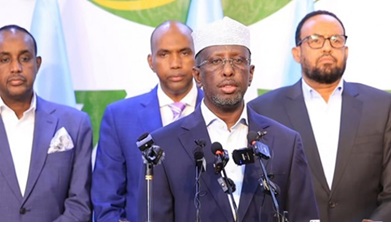
Former President Sharif Sheikh Ahmed warns that military interference in the judiciary threatens the rule of law, while opposition figures call for an internationally supported political settlement to prevent state disintegration.
MOGADISHU (WDN) — Somalia is facing an increasingly dangerous constitutional and political crisis as President Hassan Sheikh Mohamud appears determined to consolidate executive power at the expense of the country’s independent institutions. Opposition leaders have accused him of authoritarian, warning that his confrontation with the judiciary could push the country towards institutional collapse and further international isolation.
Former President Sharif Sheikh Ahmed has strongly condemned the President’s dismissal of Supreme Court Chief Justice Baashe Yusuf Ahmed, accusing the administration of interfering with judicial independence and undermining the constitutional separation of powers.
Sharif disclosed that government forces had reportedly been deployed to the Supreme Court premises to prevent the implementation of the court’s decision rejecting the President’s dismissal of its Chief Justice. He described the reported deployment as a serious assault on judicial independence and the rule of law.
He argued that the dismissal of the Chief Justice, together with other government actions he considers unconstitutional, demonstrates a growing disregard for the institutions and principles upon which a functioning state must rest.
The former President also endorsed the Supreme Court’s decision challenging the constitutional amendments, arguing that the government had failed to follow the constitutionally prescribed procedures for removing senior judicial officials. He characterised the President’s actions as unlawful and driven by personal political interests rather than constitutional authority.
Sharif warned that continued interference in independent state institutions could inflict lasting damage on Somalia’s statehood and constitutional order. He stressed that the judiciary, alongside the executive and legislature, is one of the three principal pillars of government and must remain independent of political pressure.
Opposition warns of mounting international isolation
Meanwhile, opposition parliamentarian and prominent political figure Abdirahman Abdishakur Warsame accused President Hassan Sheikh of pushing Somalia into an increasingly dangerous political and security predicament.
Abdishakur attributed the country’s deteriorating circumstances to government policies, pointing to the reported closure of the United Nations Assistance Mission in Somalia (UNSOM) and plans for the withdrawal of some foreign forces supporting the country’s security operations.
He said international forces supporting the Somali mission had been given a one-year period to leave the country, describing the development as evidence of declining international confidence and support for Somalia.
His warning comes amid growing concerns that the country’s internal political confrontation is weakening the international partnerships upon which Somalia’s security and institutional recovery depend.
Abdishakur proposed that Somalia’s political stakeholders reach an agreement on an electoral framework within 90 days, arguing that the country urgently needs leadership grounded in constitutional legitimacy. His proposal reflects growing opposition demands for a negotiated political settlement rather than unilateral decisions by the Presidency.
Military pressure against the judiciary raises alarm
The latest confrontation follows President Hassan Sheikh’s unexpected dismissal of Chief Justice Baashe Yusuf Ahmed, a move that has provoked strong objections from opposition leaders and intensified the constitutional dispute.
The situation has become even more alarming amid reports that the government is considering arresting Baashe after he rejected the President’s decision and challenged the legality of the constitutional amendments.
These reports, if confirmed, would represent a further escalation in the confrontation between the executive and the judiciary. Using security forces to intimidate or detain judicial officials over their constitutional decisions would strike at the heart of judicial independence.
Article 106 of Somalia’s 2012 Provisional Federal Constitution explicitly guarantees the independence of the judiciary from the executive and legislative branches. This principle exists precisely to prevent those exercising political power from manipulating the courts to protect their positions or suppress constitutional challenges.
The President cannot claim to defend the Constitution while disregarding the institutional independence that the Constitution itself guarantees.
International community cannot afford to look away
Somalia’s crisis is no longer simply a disagreement between the government and its political opponents. It is increasingly a confrontation over the survival of constitutional government itself.
The international community, particularly the United Nations, African Union, European Union, United States and European partners, must recognise the danger of allowing this confrontation to escalate unchecked. Their engagement should prioritise the protection of judicial independence, respect for constitutional procedures and an inclusive political settlement.
International partners should demand an independent investigation into allegations of military intimidation of the judiciary, ensure that judicial officials are protected from politically motivated retaliation and press all political stakeholders to agree on a credible electoral framework.
Where credible evidence establishes serious violations of the law, those responsible should face appropriate independent legal accountability, including through competent national or international judicial mechanisms where jurisdiction exists. Calls for accountability must not be confused with an assumption that the International Criminal Court automatically has jurisdiction over every constitutional violation.
Somalia has endured decades of institutional collapse, insecurity and political fragmentation. It cannot afford another confrontation in which the authority of the state becomes indistinguishable from the personal interests of its political leadership.
President Hassan Sheikh must understand that presidential authority is neither unlimited nor personal property. It is a constitutional responsibility, constrained by the law and exercised in the interests of the Somali people.
If the executive continues to undermine the judiciary, disregard constitutional procedures and treat political opposition as an obstacle to be eliminated rather than a legitimate component of democratic government, the consequences could extend far beyond the current administration.
The danger is not merely that Somalia will face another political deadlock. It is that the country could move closer to institutional disintegration, with devastating consequences for national unity, security and regional stability.
The international community must act before the crisis becomes irreversible. Somalia needs constitutional government, not executive domination; political negotiation, not coercion; and independent institutions, not instruments of presidential power.
WardheerNews