
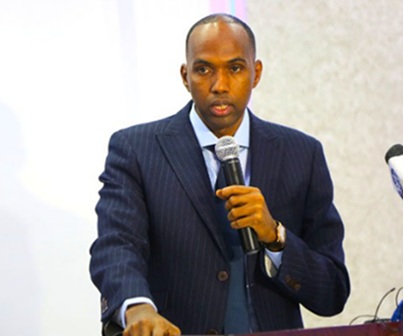
Mogadishu (WDN) — Former Somali Prime Minister Hassan Ali Khaire has launched a scathing assessment of President Hassan Sheikh Mohamud’s tenure, accusing the administration of wasting four years and three months while Somalia has experienced rising unemployment, inflation, poverty and displacement.
Khaire argued that the country’s economic performance has deteriorated significantly since Hassan Sheikh returned to the presidency, claiming that household purchasing power and business profitability have declined while the number of internally displaced people has continued to grow.
“Four years and three months after the election of a president whose term has now expired, available data confirm a significant decline in economic growth, household purchasing power and business profitability, while unemployment, inflation, poverty and the number of internally displaced people have increased substantially,” Khaire said.
He went further, accusing the administration of benefiting from what he described as the mismanagement of national assets and the appropriation of public land.
Khaire’s remarks amount to a broader indictment of what he portrays as a presidency that has failed to translate political power into tangible improvements in the lives of ordinary Somalis.
A Lost Opportunity?
The former prime minister also accused President Hassan Sheikh of damaging economic activity and undermining businesses that, he argued, were performing better before the president returned to office.
His criticism comes as Somalia continues to face multiple economic and political pressures, including high unemployment, widespread poverty, displacement and persistent insecurity.
For Khaire, the central issue is therefore not simply whether Hassan Sheikh’s administration has achieved individual policy successes, but whether the country is economically and institutionally stronger after more than four years under his leadership.
The remarks add to increasingly sharp criticism from opposition figures, who argue that the administration has devoted disproportionate attention to political consolidation, constitutional changes and electoral arrangements while failing to deliver sufficiently broad-based economic gains.
The government has rejected many of the opposition’s criticisms, pointing to progress in state-building, debt relief, international financial integration and institutional reforms.
Nevertheless, Khaire’s assessment raises a fundamental question about the legacy of Hassan Sheikh’s second presidency: after more than four years in power, has Somalia moved forward—or has the country lost valuable time while ordinary citizens have continued to bear the cost of economic hardship, displacement and political uncertainty?
For an administration approaching the end of its contested mandate, that question may prove increasingly difficult to avoid.
WardheerNews