
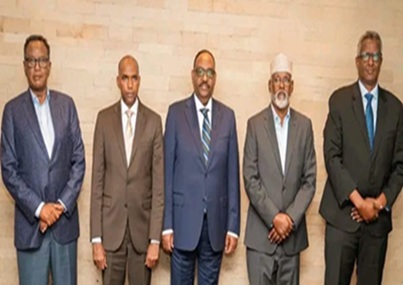
Mogadishu (WDN)_ The Future Forum of Somalia has issued one of its strongest warnings yet over the country’s deepening political crisis, declaring that Somalia has entered a period of “national emergency” and urging immediate action to prevent what it described as the collapse of constitutional governance.
Speaking at a press conference in Mogadishu, leaders of the opposition coalition argued that the country’s political deadlock has reached a critical point after more than two months of internationally mediated negotiations failed to produce an agreement between President Hassan Sheikh Mohamud’s administration and opposition groups.
The coalition accused the Federal Government of prolonging the crisis by refusing to compromise on key constitutional and electoral issues, warning that Somalia cannot continue indefinitely under institutions whose mandates are widely disputed.
Former President Sharif Sheikh Ahmed, addressing reporters, said the country was approaching a dangerous crossroads. “The situation facing Somalia today is deeply unfortunate,” Sharif said. “When the mandate of a government expires without an agreed electoral framework or political consensus on the transfer of power, the entire state enters dangerous territory.”
He urged Somali leaders to learn from the country’s past political crises instead of repeating them, warning that the absence of an inclusive political settlement could have profound consequences for national stability.
Sharif delivered perhaps the most striking comparison of the evening when he argued that Somalia’s political trajectory bears worrying similarities to Afghanistan before the collapse of its internationally backed government. He said two factors had ultimately destroyed Afghanistan: political disunity and corruption.
According to Sharif, Somalia today is struggling with both. “Afghanistan collapsed because of the absence of political consensus and because corruption hollowed out state institutions,” he said. “Unfortunately, Somalia now faces those same dangers—and in some respects the corruption challenge is even greater.”
Sharif also questioned whether the enormous international investment made in rebuilding Somalia had produced institutions resilient enough to withstand prolonged political confrontation. His remarks reflected growing concern among opposition leaders that continued political paralysis could weaken state institutions at a time when Somalia is preparing for the withdrawal of the African Union Stabilization Mission (AUSSOM).
Opposition Calls for “National Salvation”
Throughout the press conference, Future Forum leaders repeatedly described the current moment as one requiring what they called “national salvation.” They argued that the crisis has moved beyond an ordinary political disagreement between government and opposition and now threatens the legitimacy and continuity of the Somali state itself.
The coalition urged Somalis from all political backgrounds to support an inclusive political solution capable of restoring constitutional legitimacy before the situation deteriorates further. The statement follows the opposition’s earlier proposal calling for a transitional national mechanism after negotiations with the government reportedly reached an impasse.
Future Forum leaders insist that proposal is intended to preserve, rather than replace, Somalia’s state institutions until an agreed constitutional and electoral settlement can be reached.
Former Prime Minister Hassan Ali Kheyre also delivered a sharp warning, arguing that Somalia’s unresolved political crisis could damage the country’s relationships with international partners. Kheyre said prolonged uncertainty risks undermining international confidence in Somalia’s institutions at a time when external security assistance remains essential.
He pointed in particular to support provided to Somali security forces and the African Union mission, arguing that political instability inevitably raises concerns among donor governments about the country’s future direction. “The political uncertainty facing Somalia is no longer simply an internal matter,” Kheyre said. “It is beginning to affect our relationships with international partners.”
His remarks reflected broader opposition concerns that unresolved constitutional disputes could complicate future international political, financial, and security support. The opposition continues to accuse President Hassan Sheikh Mohamud’s administration of pursuing constitutional amendments and electoral reforms without securing broad national consensus.
The Federal Government, however, maintains that its constitutional and political reforms are necessary to modernize Somalia’s governance system and establish a permanent democratic electoral framework.
Those competing visions have become the central fault line in Somali politics. With internationally mediated talks now appearing to have stalled, pressure is mounting on both sides to return to meaningful negotiations before the crisis deepens further.
Dialogue Remains the Only Viable Path
Despite the increasingly confrontational rhetoric, many political observers continue to argue that sustained dialogue remains the only realistic avenue for resolving Somalia’s constitutional impasse.
A negotiated settlement would offer the best opportunity to restore confidence among political stakeholders, establish an agreed electoral roadmap, preserve institutional legitimacy, and ensure that security challenges—including the transition following AUSSOM’s planned withdrawal—are not overshadowed by internal political divisions.
Without such an agreement, analysts warn, Somalia risks allowing political polarization to weaken state institutions at a moment when national unity is arguably more important than at any time in recent years.
For now, the gap between the Federal Government and the opposition remains wide. Yet both sides continue to acknowledge that a political solution, rather than prolonged confrontation, will ultimately determine whether Somalia can navigate its constitutional crisis while preserving the gains made in rebuilding the state over the past two decades.
WardheerNews
Leave a Reply