
By Abdiqani Haji Abdi
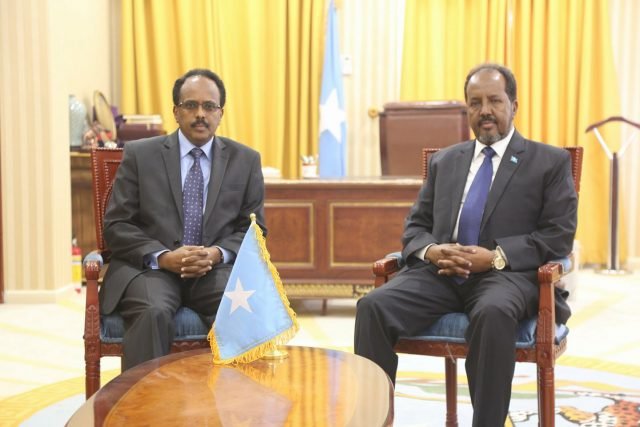
In Somalia’s modern political journey, no comparison is more revealing or more urgent than the stark contrast between former President Mohamed Abdullahi Farmaajo and the current administration of President Hassan Sheikh Mohamoud. These two leaders embody opposing philosophies of governance: one grounded in institutional building and national cohesion, the other defined by personal rule, corruption, and constitutional manipulation.
As the country sinks deeper into crisis, the differences between their tenures illuminate not only the failures of today but the possibilities squandered.
Rule of Law vs. Rule by One Man
One of the most alarming markers of President Hassan Sheikh’s second term has been his unprecedented assault on Somalia’s constitutional order. In a move that shocked legal scholars, political leaders, and international partners, Hassan Sheikh effectively discarded the Provisional Federal Constitution (PFCS) crafted and approved by parliament after years of national consultations and debate. He replaced it with a presidential constitution—drafted behind closed doors, imposed without consultation, and designed to centralize power in his hands.
This constitutional coup triggered a political earthquake. Puntland and Jubaland Federal Member States, the pillars of the federation immediately severed ties with Mogadishu. Major opposition parties followed suit, declaring that they could no longer operate under a government that behaves, in their words, like a “one-man state.” Hassan Sheikh now rules like a lone wolf, a leader who acts as if he knows all, listens to none, and consults with no one.
Under Farmaajo, constitutional reform was consensual and consultative, respecting parliamentary authority and federalism. Under Hassan Sheikh, it has become a unilateral decree—an autocratic rewrite for personal gain.
Integrity vs. Institutional Looting
President Farmaajo’s administration was defined by discipline and integrity. Public resources were protected, oversight mechanisms improved, and embezzlement networks disrupted. Farmaajo kept his family out of state contracts and shielded the presidency from business interests.
Under Hassan Sheikh, corruption has metastasized. Public lands in Mogadishu, some of the most valuable in the country have been illegally sold off, with the proceeds never reaching the treasury. Government contracts are monopolized by his family. Funds meant for public services vanish into private pockets. Many Somalis openly describe Villa Somalia today as a “commercial enterprise disguised as a presidency.”
Where Farmaajo protected the state, Hassan Sheikh privatized it.
Fiscal Discipline vs. Extravagant Waste
Farmaajo traveled sparingly and with financial caution, recognizing Somalia’s economic fragility.
In stark contrast, Hassan Sheikh has turned foreign trips into a personal spectacle, flying frequently on private jets at immense public cost. He attends minor conferences that could easily be handled by directors or civil servants—burning through millions of dollars while hospitals, teachers, and soldiers go unpaid. The country watches in disbelief as a leader presides over poverty from the comfort of chartered aircraft.
Building Institutions vs. Destroying Them
Farmaajo professionalized the Somali National Army, depoliticized the civil service, and introduced merit-based recruitment. Trained officers flourished, and Somalia’s anti-corruption framework gained credibility.
Hassan Sheikh dismantled much of that progress. The army has been fragmented, professional officers dismissed, and key institutions staffed with unqualified individuals handpicked solely based on clan affiliation. Government entities once showing promise have collapsed into political fiefdoms.
Somalia has shifted from building a state to building a personal power network.
Federal Cooperation vs. Federal Punishment
Under Farmaajo, Federal Member States (FMS) received their development funds even when political tensions ran high. He upheld the federal compact as a constitutional obligation, not a transactional favor.
Hassan Sheikh weaponizes federalism. FMS that refuses to align politically—especially Puntland, Jubaland States—are starved of international development funds. He has even sent the national army to confront regional states – Jubaland, using force where dialogue should prevail. By cutting resources to millions of citizens, he punishes entire populations for the political decisions of their local leaders.
Where Farmaajo built bridges, Hassan Sheikh burns them.
National Vision vs. Personal Power
Farmaajo’s presidency advanced debt relief, improved financial governance, strengthened the rule of law, and unified the country against extremist threats. His administration fostered optimism and restored Somalia’s credibility globally.
Hassan Sheikh’s presidency is driven by personal continuity rather than national progress. The focus is not institution-building but power consolidation. Agreements are signed without oversight, foreign alignments shift unpredictably, and domestic governance is driven by personal interest rather than policy.
Weaponization of civil aviation and love of extension of mandate
President Mohamed Farmajo used to limit the movement of the opposition figures by instructing the civilian airlines not to pick them up. President Hassan not only banning individuals from local flights but promoted the sanction to entire Federal member state airports such as Kismayo, Dollow, disrupting travel, commerce, and humanitarian aid for millions.
President Farmajo on his drive to move to one man one vote, on the advice of the all agreed upon Independent Federal Electoral Commission and the approval of the parliament extended his mandate for 18 Months. President Hassan and his groups refused and thus militarized the capital city which left 200,000 families to flee their homes. Surprisingly President Hassan is planning to overstay his mandate which expires on 15 May 2026 Without any consultation.
Somalia’s governance tools—air travel, constitutional procedures, electoral timelines—once meant to strengthen institutions, are now weapons of domination, threatening the rule of law and the fragile federal system.
The Verdict
As Somalia stands at a dangerous crossroads, the contrast between the two leaders has become a national conversation. Farmaajo is increasingly remembered as the disciplined, nation-first leader who strengthened the state and respected the constitution. Hassan Sheikh is seen as the president who collapsed constitutional order, centralized power, enriched his circle, and fractured the federation.
Somalis now look back with a mixture of frustration and clarity. They know what was working—and they can see what is failing. And in that comparison, President Farmaajo emerges not merely as the better leader, but as the one who placed Somalia above himself.
Abdiqani Haji Abdi
Email: Hajiabdi0128@gmail.com