
By Hassan Yusuf
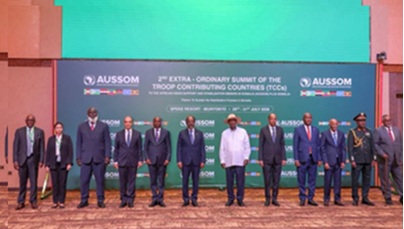
A short video circulating widely on social media has reignited an important national conversation. In the clip, President Hassan Sheikh Mohamud appears to question why Somalia’s internal political issues were reflected in the Kampala summit communiqué, suggesting that such matters should not form part of a regional document. The remarks have generated predictable political reactions, but they also raise a much more fundamental question: if Somalia’s internal political affairs are already being discussed by regional leaders behind closed doors, what exactly is achieved by removing them from the final communiqué?
This is where the debate deserves greater honesty. A communiqué is not the source of a country’s political problems. It is merely a record of what leaders considered important enough to discuss. If Somalia’s political disagreements occupy a significant place during a regional summit attended by Heads of State and Government, then the issue is not the wording of the communiqué. The issue is why Somalia’s domestic politics have become significant enough to command the attention of the region.
No Somali would welcome unnecessary external involvement in national affairs. Every nation values its sovereignty and the right to determine its own political future. But sovereignty is not protected simply by objecting to language in diplomatic documents. Sovereignty is strengthened when national institutions are capable of resolving political disagreements without requiring regional mediation or international concern. The strongest demonstration of independence is not insisting that others remain silent; it is showing that the country’s own political system is functioning effectively.
Somalia occupies a unique place in the Horn of Africa. Its security, economy, coastline, migration patterns, and political stability directly affect its neighbours. Instability in Somalia does not stop at its borders. Trade corridors are disrupted, humanitarian needs expand, refugee movements increase, security cooperation becomes more complex, and regional economic integration slows. For that reason, Somalia’s political developments inevitably become matters of regional interest. This is not because neighbouring countries wish to interfere in Somalia’s sovereignty, but because they inevitably bear the consequences of prolonged political uncertainty.
That reality explains why discussions about Somalia at regional summits increasingly extend beyond military operations and security cooperation. Political consensus, constitutional implementation, relations between the Federal Government and Federal Member States, electoral processes, and governance have all become subjects of regional concern because they directly influence peace and stability across the Horn of Africa. Pretending these issues remain purely domestic does not make their regional implications disappear.
The greater concern is that Somalia often appears to spend more energy debating how political realities are described than addressing the realities themselves. Whether the issue is a communiqué, a press statement, or an international report, public attention frequently shifts to the wording instead of the substance. Yet changing the language of a document has never resolved a constitutional dispute, restored political trust, or produced national consensus. Only dialogue can achieve that.
Perhaps the question Somalis should be asking is not why regional leaders discussed Somalia’s internal political situation. The more important question is why those issues required discussion at a regional summit at all. If relations between political stakeholders were functioning smoothly, if constitutional questions had been settled, if elections were broadly accepted, and if institutions enjoyed widespread confidence, Somalia’s domestic politics would rarely dominate regional meetings. Stable countries are discussed for their contributions to regional integration, trade, investment, and shared prosperity-not because their internal political disputes require collective attention.
This is not an argument against regional engagement. The Horn of Africa is an interconnected region where cooperation is essential. Regional organizations have an important role in supporting peace, security, economic development, and collective stability. But sustainable political solutions cannot be imported. They must emerge from Somali-led dialogue built on compromise, mutual respect, and a shared commitment to national interests above political competition.
The viral video should therefore serve as an opportunity for reflection rather than polarization. Somalia deserves a serious national conversation about why its political disputes continue to attract regional attention and, more importantly, what can be done to change that reality. The country’s future will not be secured by editing diplomatic communiqués. It will be secured by building political consensus, strengthening institutions, completing constitutional reforms, and restoring confidence among all stakeholders.
In the end, the Kampala communiqué is not the story. It is only a symptom. The real story is Somalia’s unfinished political conversation-one that only Somalis themselves can complete. When that conversation is finally concluded with wisdom and compromise, future regional summits will speak of Somalia not as a political challenge to be managed, but as a stable partner helping shape the future of the Horn of Africa.
Hassan Yusuf
Email: hyusufka@gmail.com
——————–
Hassan writes about current politics in the Horn of Africa Region