
By Abdirahman Yusuf Abdi
Introduction
Climate change has gone beyond environmental degradation in recent years, becoming a significant driver of conflict and instability in vulnerable regions, notably in fragile states such as Somalia.
Somalia, known for its arid environment and complex sociopolitical situation, is at the core of a rapidly developing climate-security problem. A growing cycle of droughts, floods, and unpredictable rainfall patterns is currently plaguing the country, changing not just its natural ecosystems but also its sociopolitical dynamics. This article examines at how these climate-related issues are more than just ecological issues; they are also fundamental causes of resource-based rivalry, violent conflict, and relocation.
Historically, Somalia’s conflicts have been understood through the lens of political instability, clan-based rivalries, and weak governance structures. However, an emerging body of research and evidence points to climate change as a force multiplier—exacerbating existing grievances, weakening social cohesion, and deepening economic fragility. In particular, recurrent droughts have decimated livelihoods, especially in pastoralist and agro-pastoralist communities, where the loss of livestock and arable land has led to mass displacement and intensified competition over water and grazing resources. As scarcity worsens, these tensions often erupt into localized conflicts that can easily spiral into broader instability, especially in areas already underserved by the state.
The link between environmental stress and conflict in Somalia is not abstract. For example, between 2021 and 2023, over 3.8 million people were displaced by a combination of drought and conflict. In 2024, climate projections show no sign of reprieve, and if decisive action is not taken, up to 8 million people—almost half of the population—could face acute food insecurity. The nation’s coping systems, already strained by decades of civil war, limited infrastructure, and inadequate governance, are ill-equipped to manage the compounding pressures of climate change and conflict. This reality underscores the urgency of reframing climate adaptation as not only an environmental imperative but also a core element of peacebuilding and national security.
Moreover, the breakdown of traditional resource-sharing agreements among clans has created a vacuum that further destabilizes intercommunal relations. In regions like the Jubba Valley, Gedo, Bay, Bakool and central Somalia, climate-induced migration is increasing population density in limited safe zones, creating flashpoints for new grievances and renewed violence. The inability of national institutions to equitably manage resource access or mediate disputes further intensifies these risks. Humanitarian aid and peacekeeping interventions, while vital, are often reactive rather than preventive, addressing the symptoms rather than the structural causes of conflict.
2024 must be recognized as a pivotal year. As global awareness of climate security grows, Somalia stands at a crossroads. The current climate-conflict dynamics represent both a warning and an opportunity. Effective solutions must be multi-dimensional—incorporating climate resilience, conflict sensitivity, and community-driven peacebuilding approaches. The collaboration of national authorities, local leaders, international agencies, and civil society is essential. Only through inclusive planning and long-term investment in environmental governance can Somalia begin to reverse the cycle of drought to discord.
This article seeks to contribute to that dialogue by exploring the intricate relationship between climate change and conflict in Somalia. Drawing on both local experiences and global frameworks, it outlines the environmental drivers of violence and evaluates possible strategies for sustainable peace. By doing so, it calls attention to the urgent need for integrated policies that address not only environmental degradation but also its social and political consequences. The future stability of Somalia—and the safety and dignity of its people—may depend on how decisively and collaboratively we act today.
Understanding Somalia’s current climate crisis
Somalia’s Current Climate Change Situation
In the Horn of Africa, Somalia is particularly vulnerable to the effects of climate change. Due to its geographical location, this country is subject to harsh climate conditions that have a significant impact on the environment and population. Recurrent droughts, irregular rains, and catastrophic flooding are all common occurrences that exacerbate Somalia’s existing fragile situation.
Changes in Temperature
Somalia has experienced an increase in temperature of about 1-1.5°C since 1991. Millions of Somalis now face tougher living conditions as a result of this growth; it is more than simply a statistic. According to projections, temperatures might climb by an unsettling 3.2–4.3°C by 2100. Extreme weather events will probably become more frequent and severe as a result of these significant changes, presenting even bigger challenges for the nation.
Over the past few decades, average temperatures in Somalia have gradually increased. While this rise may seem small on a global scale, it has major local consequences. Hotter temperatures dry up surface water, reduce soil moisture, and lead to more frequent heatwaves. Pastoralist communities, which rely heavily on grazing land and water sources for their herds, now struggle to find sustainable pasture.
As a result, many are forced to travel longer distances or abandon their traditional migration patterns, placing pressure on already stressed ecosystems and fueling local disputes.
Droughts
In Somalia, droughts are a common problem that can last for several seasons and have a significant negative impact on agricultural output.
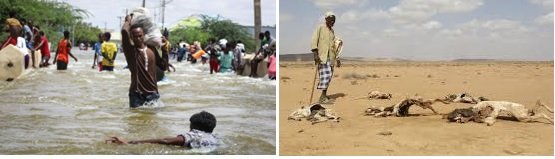
In addition to rising heat, Somalia suffers from recurring droughts that destroy crops and kill livestock. The 2011 and 2017 droughts were particularly devastating, pushing millions into food insecurity and triggering large-scale displacement. Today, drought continues to displace families from their homes, with many ending up in overcrowded camps where access to clean water and sanitation is minimal. These conditions often lead to disease outbreaks and further strain limited humanitarian resources.
Floods
Flooding is another serious hazard.
- 2020 Floods: Extensive floods brought forth by heavy rains affected over 500,000 people and forced almost 400,000 others to relocate.
- Seasonal flooding: This phenomenon usually occurs between April and June during the Gu` and Dayr (October to December) rainy seasons, hence intensifying food shortages and displacement concerns.
Flooding presents another growing challenge, though drought dominates public concern, heavy rains during seasonal transitions have caused destructive floods across river basins, especially in southern Somalia. In cities and low-lying rural areas, floodwaters damage homes, schools, and vital infrastructure. The combination of poor drainage systems and weak local governance limits the country’s ability to respond to these disasters. When floods destroy agricultural land, families lose not only their income but also their ability to feed themselves.
Communities across Somalia are feeling the impact. Farmers plant crops only to watch them fail due to erratic rainfall. Herdsmen sell off weakened livestock at low prices before they die of thirst or hunger. Women and children walk for hours just to collect water, exposing themselves to risks along the way. With traditional coping mechanisms stretched to the limit, many families are left with few choices: move, compete for resources, or depend on aid.
Effects on the Communities
This climate emergency is not just an environmental issue—it threatens Somalia’s social fabric. As climate shocks become more frequent, they heighten tensions over land and water, deepen economic hardship, and fuel cycles of displacement. Without urgent action, these environmental stresses will continue to undermine peacebuilding and development efforts.
Somalia’s climate crisis is real, immediate, and complex. It calls for coordinated efforts from government institutions, humanitarian agencies, and local communities to develop solutions that protect both people and the environment. If ignored, the worsening climate will push the most vulnerable even closer to the edge—and make lasting peace harder to achieve.
Communities are devastated by these extreme weather events because they:
a) Destroy crops and livestock
b) Disrupt water supply systems
c)Increase food insecurity
d) Push people migrate from their homes
For many Somalis, the combined effects of these climate pressures create an ongoing cycle of poverty and displacement. However, attempts are being undertaken to address these difficulties through a variety of adaptation measures targeted at increasing the resilience of affected communities.
Read more: Climate Change as a Trigger for Conflict in Somalia: From Drought to Discord
Abdirahman Yusuf Abdi
Email: