
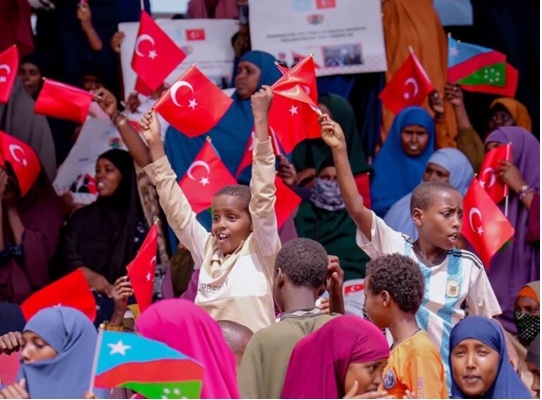
Baidoa (WDN) — Three days after reports of alleged Turkish airstrikes around Baidoa—and less than two weeks after anti-Türkiye protests erupted elsewhere in Somalia—a crowd gathered in the city on Tuesday, September 15, waving Turkish flags and praising Ankara. The timing could hardly be more striking.
Hundreds of people gathered at Dr. Ayuub Stadium, carrying Turkish and Somali flags and expressing support for the longstanding relationship between Somalia and Türkiye. Organizers described the event as a demonstration of gratitude for Turkish assistance in security, development and humanitarian affairs. But the rally took place against a dramatically changed political backdrop.
On September 12, reports emerged of alleged Turkish airstrikes around Baidoa, including claims of casualties and damage. The reports have not been independently verified, and neither Türkiye nor the Federal Government has publicly confirmed responsibility.
The demonstration also came less than two weeks after the September 3–4 Doolow incident, when Jubaland officials accused Turkish aircraft of striking the residence of former Somali security commander General Mahad Abdirahman “Taliye Shub.” The allegations triggered protests in several parts of Somalia, including demonstrations in which Turkish flags were reportedly burned.
The Federal Government disputed elements of the account, while Türkiye has not publicly acknowledged responsibility for the alleged strike. Critics question whether Tuesday’s gathering represented spontaneous public enthusiasm or a politically organized effort to demonstrate that Ankara still enjoys popular support.
Some political opponents allege that former Speaker Sheikh Aden Mohamed Nur “Aden Madoobe” and political allies associated with the current South West administration helped organize or finance the rally.
The allegation is politically significant because Turkish military assistance has become increasingly entangled with the confrontation surrounding Baidoa and the forces aligned with the Federal Government.
There is, however, no independent evidence publicly establishing that Aden Madoobe personally financed the demonstration. The claim should therefore be treated as an allegation rather than an established fact.
A Relationship Under Pressure
For years, Türkiye enjoyed an unusually positive image in Somalia. Erdoğan’s visits, Turkish humanitarian assistance, infrastructure projects, scholarships, health services and military cooperation helped establish Ankara as one of Somalia’s most prominent international partners.
The Turkish flag was widely associated with friendship and solidarity. That image is now under pressure. Protests and flag-burning incidents reported in recent weeks suggest that Türkiye’s military role has become increasingly controversial among sections of the Somali public. The dispute is no longer simply about development assistance or diplomatic relations. It is increasingly about whether Ankara has become involved in Somalia’s internal political and security conflicts.
That distinction matters. Türkiye has trained Somali forces, provided military equipment and developed an extensive defense relationship with the Federal Government. Turkish armed drones have also been associated with Somalia’s counterterrorism campaign.
But when Turkish aircraft or drones are alleged to have been used in operations connected to domestic political confrontations, the perception of Ankara’s role changes. A security partnership can quickly become a political liability if communities begin to associate it with controversial military operations.
Why Baidoa Is Different
Baidoa is at the center of that controversy. The city has become a major arena in the confrontation between the Federal Government and forces associated with former South West President Abdiaziz Hassan Mohamed Laftagareen.
As a result, Turkish military involvement in or around the region is being interpreted through an increasingly political lens. For Federal Government supporters, Ankara remains a strategic partner helping rebuild Somalia’s security institutions and combat Al-Shabaab.
For opponents, the same military relationship has become evidence of foreign involvement in Somalia’s internal political struggle. The September 15 rally therefore carries significance beyond the crowd gathered at the stadium.
Its timing raises questions about whether the demonstration was intended, at least in part, to counter the growing backlash against Türkiye and reinforce the image of a continuing Somalia–Türkiye partnership.
The Bigger Question for Ankara
A single demonstration cannot determine public opinion across Somalia. Nor can photographs of people waving Turkish flags erase the anger expressed in other parts of the country.
The more consequential question is whether Türkiye can maintain its longstanding relationship with Somalia while avoiding the perception that it has become aligned with one side of the country’s increasingly polarized political landscape. That challenge is particularly acute because Türkiye’s influence in Somalia has been built on two pillars: development and security. The first created goodwill.
The second now risks becoming the source of controversy. For Ankara, the distinction between supporting Somalia’s national security institutions and becoming involved in Somalia’s internal political disputes will therefore be increasingly important.
For Mogadishu, the issue is equally sensitive. Foreign military assistance may strengthen the government’s capabilities, but if that assistance becomes identified with one faction in a domestic confrontation, it can deepen political divisions rather than resolve them. And for ordinary Somalis, the contrast is increasingly difficult to miss.
In Baidoa, Turkish flags were raised on September 15. Elsewhere, they were burned. That is not simply a contradiction between two demonstrations. It is evidence of a relationship undergoing a profound political test.
The Somalia–Türkiye friendship that once appeared almost unquestionable is now being debated in the streets—and its future may depend less on official speeches than on how Somalis perceive Ankara’s actions on the ground.
WardheerNews