
By Wilo Abdulle Osman
The Council of Elders of Abudwaq District, a representative body of 33 members, including 21 traditional elders, 8 youth representatives, and 4 women, have issued a formal declaration of its unequivocal opposition to the proposed federal government-led population registration and subsequent electoral process for the district. The announcement, made public on August 31, 2025, articulates profound and widespread apprehension regarding the timing, procedural integrity, security, and fundamental inclusivity of the electoral preparations currently being advanced within Galmudug State.
This deliberative body reached its conclusion through a formal vote, in which 29 representatives voted to oppose the registration plan, 2 members voted in support, and 2 members abstained from the vote. This decisive majority reflects a significant undercurrent of local resistance to the current electoral framework, a sentiment compounded by the region’s complex and unresolved political and security challenges.
I. Contextual Background: Electoral Initiatives and the Erosion of Local Governance
The district of Abudwaq possesses a historical precedent for elected local governance through a Local Council. The recent initiative commenced with the arrival of members of the Federal Election Committee, whose stated intention was to conduct a comprehensive population registration of the district’s residents. Their operational plan included sequential meetings with the incumbent Local Council, the Council of Elders, and various other community segments, to be followed by the establishment of registration centres at several strategic locations across the city.
The committee announced an ambitious 50-day timeframe to complete this task. However, from its inception, public opinion on the initiative has been sharply divided. A considerable portion of the community perceives the process not as a neutral administrative exercise, but as a political manoeuvre designed to manipulate upcoming state and federal elections. This perspective alleges that the process is engineered to favour the return to power of President Hassan Sheikh Mohamud and to ensure the political dominance of the Hawiye clan. These views are reportedly promoted by Galmudug State President Ahmed Abdi Karie ‘Qoorqoor’ and allied state ministers who represent the district. Compounding these concerns is a prevailing fear that the Galmudug administration aims to strategically replace the current district leadership with figures who would serve private and partisan interests rather than the collective welfare of the community.
II. The Critical Security Situation and Its Impact on Electoral Integrity
The security environment in Abudwaq has deteriorated sharply, presenting a fundamental impediment to any credible electoral activity. The district police station remains closed and non-operational following a violent clash between police forces and the clan of a local hotel owner, a confrontation that resulted in three fatalities. Darawish forces, which were previously active in providing security within the district, have had their salaries suspended by the state administration, a situation that raises the potential for these forces to protest by blocking major roads.
Furthermore, federal intelligence forces have withdrawn entirely from the area following confrontations with local groups over the confiscation of illegal weapons. Critically, there are no federal military forces presently stationed in the district to provide a stabilising presence.
The clan of the hotel owner, now armed and demanding justice, remains engaged in ongoing armed standoffs with the remaining police elements. While traditional reconciliation efforts are understood to be underway, the situation remains entirely unresolved. Until a resolution is achieved, the local police and judicial courts cannot functionally operate. The vacuum left by these absent state security forces has been filled by heavily armed tribal militias that now roam the area, significantly heightening tensions and rendering the environment untenable for a peaceful civic process.
Given this acute instability, the Council of Elders concluded that any attempt at electoral registration is imprudent and cannot proceed without first securing the district. They stressed the absolute necessity of conducting extensive public awareness campaigns to address the sharply divergent public views on the process before any registration activities could legitimately begin.
III. Procedural Details, Equitable Concerns, and Local Staff Recruitment
The elders met with the federal staff responsible for implementing the registration and electoral process. During these meetings, they were informed that 120 local personnel from the Abudwaq district would be recruited to assist with the work. The proposed implementation schedule was outlined as follows: a one-day meeting with the Local Council, a one-day meeting with the Council of Elders, a one-day meeting with various community groups, and finally, the setting up of registration equipment at four locations in the city to commence registering residents.
This proposed staffing level of 120 personnel directly mirrors that allocated to the Guriceel district. This allocation has raised significant concerns within the Abudwaq Council regarding equitable resource distribution, given that Abudwaq possesses a significantly larger and more dispersed population than Guriceel. The elders perceive this identical allocation as a failure to account for demographic realities, thereby potentially disenfranchising their constituents and bringing the fairness of the entire process into question.
IV. Synthesis of Security and Legitimacy Concerns
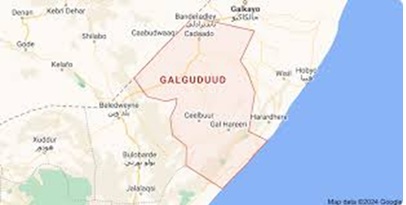
Abudwaq is a populous district located in the western part of the Galgaduud region, characterised by a predominantly pastoralist population and a strategically significant position near the disputed Somali-Ethiopia border. Its historical governance by an elected Local Council stands in stark contrast to its current reality of a rapidly deteriorating security environment. The council of elders synthesises the situation by directly linking the absence of security to the absence of legitimacy. They argue that the closure of the police station, the withdrawal of forces, and the presence of armed militias have collectively created an environment of fear and instability that makes a credible electoral process impossible.
The council also expressed serious concerns over the absence of federal military forces and the suspension of salaries for local security personnel, acts which further destabilise the district. The elders warned unequivocally that proceeding with registration under these conditions not only risks escalating existing conflicts but also irrevocably undermines the legitimacy of any electoral outcome.
V. Core Demands: Transparency, Inclusivity, and Constitutional Compliance
The elders stressed that any legitimate electoral activity must be transparent, inclusive, and firmly grounded in the foundational principles of the Somali Provisional Constitution of 2012. They emphasised the point of principle that “No registration or electoral process can be legitimately conducted in Abudwaq without a nationwide, agreed-upon, and inclusive electoral framework.” Any initiatives that do not comply with constitutional provisions or that appear to favour particular clans or political interests were therefore outright rejected.
Concerns regarding potential political manipulation were reiterated. The elders expressed the community’s view that the registration effort is an attempt to improperly influence state and federal elections. They criticised the involvement of the Galmudug administration, stating, “There are fears that current district leadership may be replaced by those serving private agendas rather than the community’s interests.”
VI. Advocacy for Equitable Treatment and Participatory Governance
The council’s declaration extended beyond the immediate electoral issue to highlight the critical need for equitable treatment of all districts within Galmudug State. The elders made the case that historic districts such as Abudwaq, Dhuusamareeb, and Ballanballe deserve equal rights, resources, and political representation when compared to newer districts like Guriceel and Dhabad.
“We call for a balanced approach that respects the historical significance and current needs of all districts,” said a Council spokesperson. They added, “Development projects, administrative offices, and public services must be distributed fairly to ensure social cohesion and political stability.”
The council urged the reinstatement of administrative functions that had been unfairly relocated—such as the customs office moved from Abudwaq to Huurshe—and called for the impartial deployment of security forces to protect all communities without prejudice. Furthermore, the elders advocated for the establishment of inclusive dialogue forums that would engage representatives from each district to foster trust and collaborative governance. “Community involvement in decision-making is essential for building ownership and sustainable peace,” they affirmed.
VII. Ensuring Public Awareness and Pastoralist Inclusion
Acknowledging that approximately 60% of Abudwaq’s population are pastoralists who reside in rural areas, the elders emphasised that any future registration process must include registration centres established outside of urban locations to prevent the disenfranchisement of this significant demographic. They also stressed that extensive public awareness campaigns are a prerequisite to address divergent views and build public confidence in any electoral process.
The fact that the registration staff intended to recruit only 120 local personnel, a number mirroring that of the smaller Guriceel district—which was not officially recognised before 1991—was cited as a primary example of the unfair and inequitable approach that threatens the legitimacy of the entire endeavour.
VIII. Public Mandate and Ratification
The decisions ratified by the Council of Elders on August 31st were presented and thoroughly discussed in a large public meeting with the residents of Abudwaq on September 1st. The community’s response was one of full and unambiguous agreement with the Council’s position.
As expressed by representatives of the community: “Regarding the registration and electoral process, we have rejected, halted, and opposed it; it was neither presented to the public nor consulted with us, and we do not acknowledge or consider it. Our support is clear and unwavering. On behalf of the people of Abudwaq, we have voiced our position and formally submitted it,” said one community representative.
“The 33 elders of the Council, who have examined this matter from every angle, serve as guardians of this society and protectors of the community’s best interests. We are here to reinforce and uphold the decisions made by the Council of Elders,” stated a female community representative.
IX. Conclusion: A Call for Dialogue and a ‘Security-First’ Principle
The Council of Elders concluded that the registration and electoral process cannot proceed under the current conditions. Their formal position is that any such process must be preceded by the establishment of security and the comprehensive addressing of community concerns. “We respect the will of the people and support registration conducted in accordance with the law,” stated an elder, “but only when the environment is safe and the process is transparent and inclusive.”
They urged both Galmudug state and federal authorities to engage in genuine, good-faith dialogue with local leaders, to prioritise the resolution of critical security issues, and to ensure strict adherence to national and state laws. As the elders summarised, “Without these conditions, any attempt at public registration and elections risks deepening divisions and alienating our people.” The Council reaffirmed its commitment to advocating for the rights and interests of the Abudwaq community and called for equal rights and opportunities for all districts within Galmudug. “We were informed that indirect elections would be implemented in this area, and we have responded with an indirect decision,” the elders concluded, underscoring their strategic and principled opposition.
Wilo Abdulle Osman
Email: Wilo.abdulle@gmail.com
Nairobi, Kenya