
By Ahmed A. Yusuf
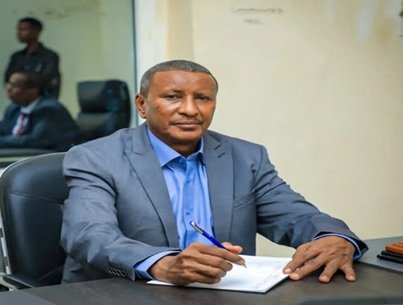
When Maxamuud Caydiid Dirir stepped behind the podium in Garowe on a warm Wednesday morning, no one expected what was about to unfold. The Minister of Information for Puntland, known for his brash style and unfiltered rhetoric, was expected to address a recent statement made by Somalia’s Prime Minister Hamza Abdi Barre, who had accused the Puntland administration of marginalizing its own citizens.
But what began as a routine rebuttal quickly turned into something else entirely — a stunning verbal assault that shocked the nation, triggered a wave of condemnation, and left many questioning whether Somalia’s already fragile political fabric could endure another tear.
“Hamza is a political corpse,” Dirir declared, his tone unwavering. “He needs to be liberated from Villa Somalia. He has no decision-making power in his office, and frankly, I’m not even convinced he is Somali. I believe he’s one of those who were left behind in Mogadishu in 1991 — no one knows his roots.”
The remarks hit like a political grenade. Within hours, social media lit up. Outrage swept across Somalia — from Puntland to Kismayo, from Baidoa to Mogadishu. Hashtags denouncing Dirir’s comments began trending, and the story dominated the airwaves and online platforms.
In Puntland, a region proud of its autonomy and political maturity, voices rose in dissent. Dozens of intellectuals, elders, and political figures released statements condemning the remarks and urging President Said Abdullahi Deni to remove Dirir from office.
“The Minister’s words do not reflect the values or dignity of the people of Puntland,” the statement read. “We extend our apologies to Prime Minister Hamza, his family, and all Somalis.”
“It was more than an insult,” said Safiya Jama, a civil society activist based in Bosaso. “It was an attack on national unity. To question a Somali’s identity — especially a public figure like the Prime Minister — is not just bad politics. It’s a dangerous precedent.”
The comment about Hamza being “a corpse” was seen by many as grotesque and dehumanizing. But perhaps even more disturbing to the public was Dirir’s open challenge to the Prime Minister’s Somali lineage. Somalia, a nation torn apart by decades of clan warfare and displacement, remains haunted by its past. Identity is a deeply sensitive subject, and for many Somalis — especially those who fled during the civil war — such accusations are not just offensive but traumatic.
In Mogadishu, lawmakers voiced their anger in Parliament. One MP from South West State called the remarks “verbal terrorism.” Another accused the Puntland minister of attempting to provoke inter-clan hatred under the guise of political commentary.
Prominent Somali scholar Dr. Ahmed Ali, writing from Nairobi, warned, “This kind of rhetoric unearths old wounds and threatens to undo the delicate progress we have made. There must be accountability.”
But as of Wednesday evening, there had been no official response from President Deni — no apology, no dismissal, no public statement. His silence, many noted, was deafening.
“If President Deni does not act, it sends a chilling message,” said Yasin Gure, a political analyst in Garowe. “That such hate speech is tolerated — or worse, endorsed — at the highest levels of Puntland’s government.”
Observers say this controversy comes at a time when tensions between Puntland and the Federal Government are already at a boiling point. President Deni has long opposed federal attempts to centralize power and has resisted several national initiatives, including the rollout of universal suffrage and the recently proposed constitutional amendments. But despite their political differences, many believed there remained a line of mutual respect between regional and federal leaders.
That line, it seems, has now been crossed.
“This is not just about politics,” said journalist Ayaanle Abdullahi. “It’s about dignity. It’s about the kind of Somalia we are trying to build — one based on inclusion, dialogue, and mutual respect. Dirir’s remarks spit on all of that.”
In Mogadishu, Prime Minister Hamza has not publicly responded to the insults. His office issued a brief statement calling for restraint and urging all officials to “uphold the honor and decorum befitting their positions.” Behind closed doors, aides said the Prime Minister was more disappointed than angry — and committed to taking the higher ground.
But within the Somali diaspora, the reaction was far more firm. Somali communities in Nairobi, London, and Minneapolis organized online forums and issued letters of support for Hamza.
“This was an attack on all of us” said Layla Shire, a Somali-American community leader in Minnesota.
The outrage has now turned to demands for concrete action. Activists and political figures across Somalia are calling for the establishment of a national code of conduct for government officials — one that holds them accountable for language that incites hatred or undermines national unity.
“This should be a turning point,” said former diplomat Fadumo Warsame. “If we allow this to go unchecked, we are endorsing division. But if we respond with principle and unity, we can turn this insult into a moment of clarity.”
As the sun sets on another tense day in Somali politics, the people wait. Will President Deni respond? Will Maxamuud Caydiid Dirir be held accountable? Or will this moment be swept under the political rug, like so many before it?
In the streets of Garowe, the question is on everyone’s lips. In the halls of Villa Somalia, the silence is heavy. And in the hearts of many Somalis, a simple plea echoes: Let us not go backward. Not again.
Ahmed A. Yusuf
Email: aayuusuf44@gmail.com